
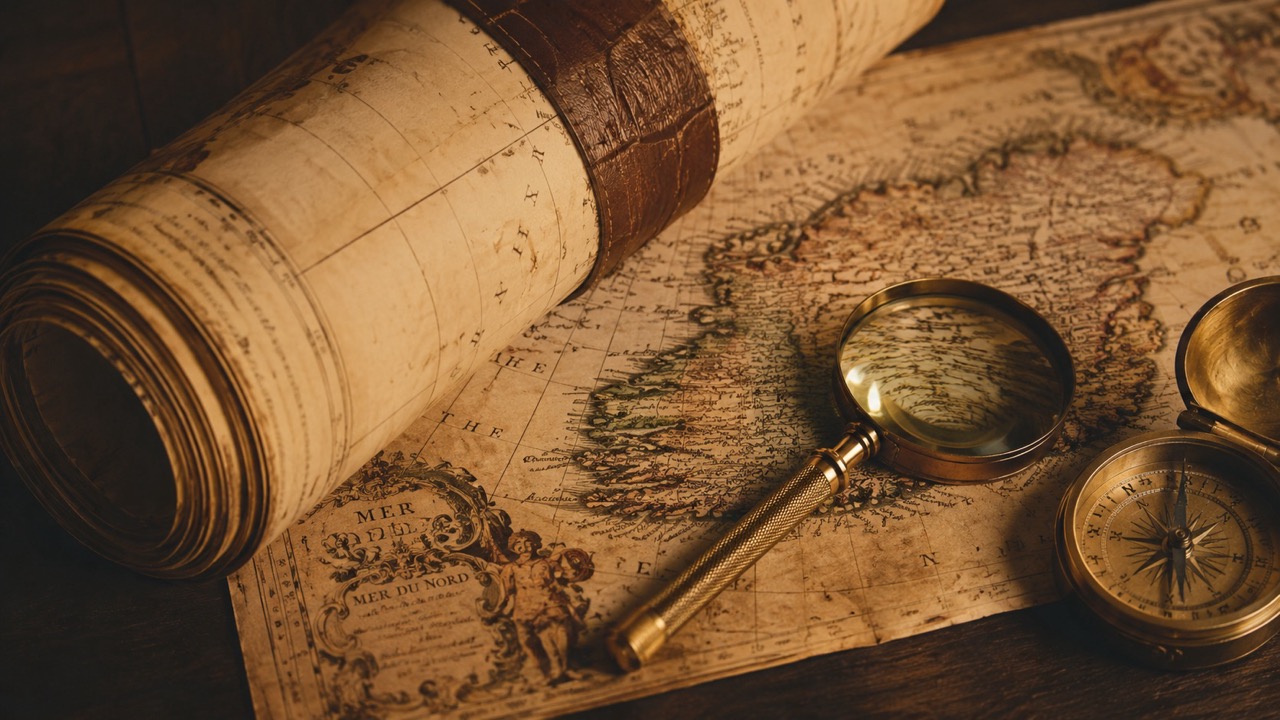
The romance of the trade route lies not in the commodity it carried but in the civilisation it created along its path. Wherever saffron, silk, or silver moved in quantity — across mountain passes, through desert caravanserais, along maritime corridors that connected continents — the traffic generated settlements, markets, cathedrals, mosques, inns, customs houses, and the kind of cultural cross-pollination that produces architecture, cuisine, and craft traditions of lasting interest. The great trade routes of history are not abstractions confined to economic textbooks. They are physical realities, traceable on the ground, and three of the most consequential can still be followed by the traveller willing to move at a pace that honours the journeys that created them.
The Saffron Road: From Kashmir to La Mancha
Saffron — the stigma of Crocus sativus, harvested by hand in quantities so small that seventy thousand flowers yield a single pound of spice — has been the most valuable agricultural product by weight for at least three millennia. Its journey westward from its probable origin in the highlands of Iran and Kashmir, through the Arab conquest of the Iberian Peninsula and into the saffron fields of La Mancha, constitutes one of the great botanical and cultural migrations in history. To trace it today is to travel through landscapes that saffron shaped: the fields of Pampore in Kashmir, where the October harvest turns the valley purple; the souks of Isfahan, where saffron merchants still operate from shops whose tile-work dates to the Safavid dynasty; the meseta of Castilla-La Mancha, where the Denomination of Origin saffron of Consuegra is harvested and processed by methods that have changed little since the Moors introduced the crocus to Spain in the tenth century.
The cuisine at each station along this route bears saffron’s signature. The Kashmiri rogan josh, the Persian tahdig, the Milanese risotto, the Provençal bouillabaisse, the Spanish paella — each represents a local adaptation of the same precious ingredient, and to eat one’s way along the saffron road is to taste how a single spice, moving through different culinary traditions, produces an astonishing range of expression.
The Silk Road: Samarkand, Bukhara, and the Caravanserais
The Silk Road — the network of overland routes that connected Chang’an to Constantinople across six thousand kilometres of steppe, desert, and mountain — was never a single road and never carried only silk. It was a system, and the places where that system concentrated its energies — the oasis cities of Central Asia, the caravanserais that provided shelter at intervals calculated to a camel train’s daily range, the mountain passes whose control determined the flow of goods between empires — are among the most architecturally and culturally rich destinations available to the contemporary traveller.
Samarkand, the city that Tamerlane rebuilt as the capital of his empire in the fourteenth century, remains the most visually extraordinary of the Silk Road cities. The Registan — three madrasas facing each other across a single plaza, their facades covered in tilework of a chromatic intensity that photography consistently fails to capture — is one of the great architectural ensembles of the Islamic world. Bukhara, older and more intimate, preserves its trading infrastructure with remarkable completeness: the covered bazaars, the domed trading halls, the brick minarets that served as landmarks for approaching caravans. The journey between them — through a landscape of cotton fields and irrigated oases that has supported settled civilisation for five thousand years — is a journey through the physical infrastructure of premodern globalisation.
The Silver Route: Potosí to Seville
The discovery of silver at Potosí, in present-day Bolivia, in 1545 created a flow of wealth that reshaped the global economy and left physical traces across two continents. The silver was mined by forced indigenous and African labour under conditions of extraordinary brutality, carried by llama train to the Pacific coast, shipped to Panama, transported overland to the Caribbean, and conveyed by fleet to Seville, where the Casa de Contratación controlled its distribution into the European economy. Every stage of this journey produced architecture: the baroque churches of Potosí, built with silver-mining wealth and decorated with a syncretic art that combines Catholic iconography with Andean symbolism; the colonial cities of Sucre and Arequipa, whose limestone and sillar buildings constitute some of the finest colonial architecture in the Americas; the great houses of Seville’s merchants, whose courtyards and tilework funded by New World silver remain among the most beautiful domestic interiors in Spain.
To follow the silver route today is to confront a history that is magnificent and terrible in equal measure — to stand in the mines of Cerro Rico, where an estimated eight million people died over three centuries of extraction, and then in the cathedral of Seville, whose gilded retable was fashioned from the same metal. The journey does not resolve this contradiction. It holds it in the mind simultaneously, which is, perhaps, the most honest thing a journey through history can do.