
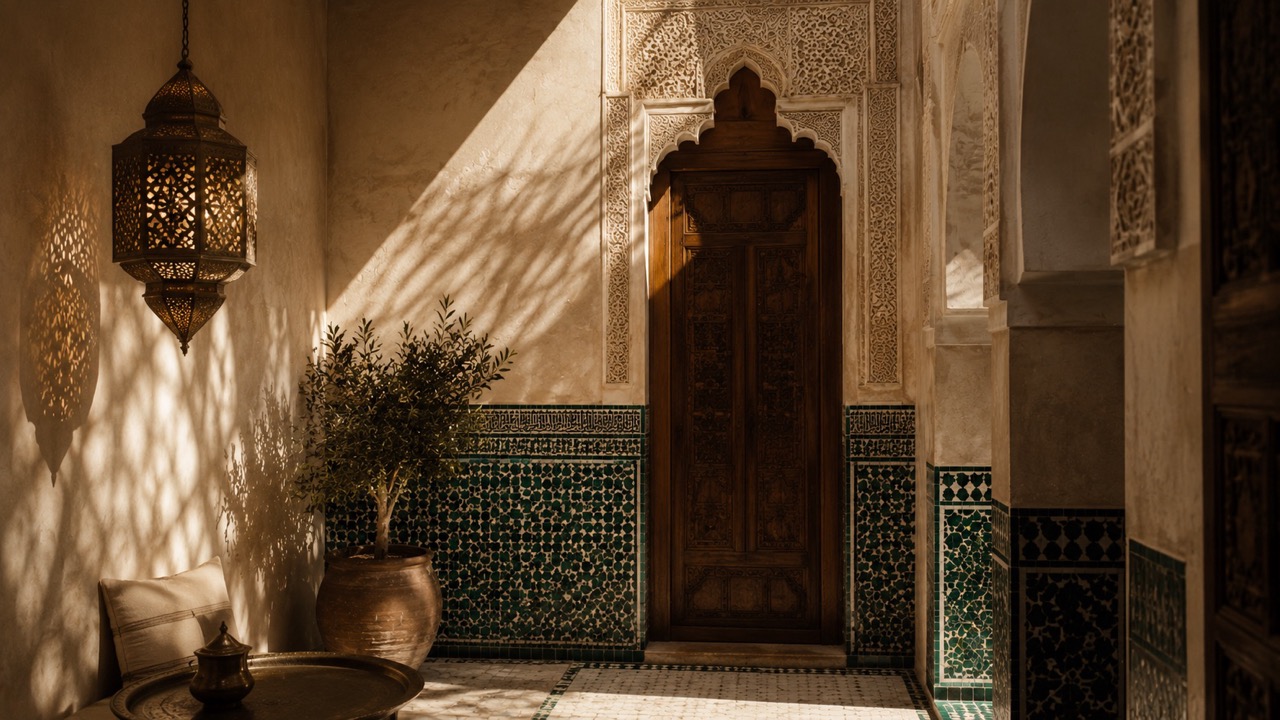
Axel Vervoordt does not choose colours; he discovers them. In the process of stripping a room back to its bones — removing plaster to reveal medieval stone, sanding floors to their raw timber, scraping away centuries of paint to find the original lime wash beneath — colour emerges as a consequence of materiality rather than a decision imposed upon it. His palette of Belgian linen, raw plaster, oxidised bronze, and waxed oak is not minimalist in the reductive sense; it is maximally attentive to what is already there. The walls of his Kanaal compound in Antwerp are the colour of themselves — the grey of concrete, the buff of aged mortar, the soft ivory of lime. Every surface carries its own history, and that history has a hue.
The Palette of Silence
Vervoordt’s approach represents one pole of the colour conversation in serious interior architecture: colour as restraint, as listening, as allowing materials to speak their own chromatic language. His rooms feel quiet — not because they lack visual interest but because the interest is subtle, requiring attentive looking. The difference between three shades of grey on a single wall becomes, in a Vervoordt interior, as dramatic as a Matisse cutout. Visitors report that after spending time in his spaces, the outside world appears almost unbearably loud — not in volume but in colour. The eye, calibrated to subtlety, finds ordinary interiors garish.
Vincent Van Duysen works in adjacent territory — the mineral palette of Belgium’s north: blue-grey stone, anthracite linen, the warm beige of unfired clay. But where Vervoordt discovers colour through archaeology, Van Duysen composes it with architectural precision. His interiors are studies in tonal control — rooms in which every surface exists within a three-note range, the variations so subtle they feel less like design decisions than like natural phenomena. A Van Duysen room in morning light and evening light are two different compositions, the same materials revealing different aspects of their chromatic character as the sun moves. This is colour used not as decoration but as temporal architecture — surfaces designed to change with the day.
India Mahdavi’s Joyful Revolution
At the opposite pole, India Mahdavi works with colour as sensation — immediate, physical, unapologetic. Her interiors deploy pink not as a tint but as an environment: the Bishop restaurant in New York, where terracotta-pink walls, pink marble tables, and pink velvet seating create a total chromatic immersion. Her greens are not accents but commitments — the pistachio of a custom sofa, the sage of a hand-glazed tile, the emerald of a lacquered cabinet, each decision building toward a room in which colour is not applied to a neutral container but constitutes the container itself.
Mahdavi’s approach is sometimes dismissed as whimsical, which misunderstands its rigour. The pinks in a Mahdavi interior are not random selections from a fan deck; they are precisely calibrated relationships — a warm terracotta beside a cooler blush beside a deeper rose — that create depth through chromatic interaction rather than material texture. Where Vervoordt achieves depth through the literal layering of plaster and stone and time, Mahdavi achieves it through the optical layering of related hues, each one advancing or receding against its neighbours to create a sense of spatial complexity within what is, materially, a simple room.
Colour as Emotional Architecture
What the masters share — despite their radically different palettes — is the understanding that colour is not a surface treatment but a spatial force. A deep blue room is not the same room as a white one painted blue; the colour alters the perceived dimensions, the quality of light, the emotional register, the way the body feels within the space. Red advances; blue recedes. Warm tones contract a room and make it intimate; cool tones expand it and make it formal. Yellow energises; grey calms. These are not metaphors; they are measurable perceptual effects with neurological bases.
The professional interior architect thinks about colour the way a composer thinks about key signature — as the fundamental tonality against which all other decisions will be made. A room’s colour is not its last decision but its first, because everything that follows — furniture, fabric, art, objects — must exist in relationship to it. Get the colour wrong and no amount of beautiful furniture will save the room; get it right and even modest furnishing acquires a quality of rightness, of belonging, that transcends the individual merits of any piece.
Specific Rooms, Specific Reasons
In Pierre Yovanovitch’s Paris apartment, a library is painted in a deep, saturated green that makes the room feel like the interior of a jewel box — intimate, precious, completely enclosed. The colour was chosen not for its fashionability but for its optical effect on human skin: in green light, skin takes on a warmth and vitality that makes its inhabitants appear healthy and attractive. This is colour used with the precision of stage lighting — an environment engineered to flatter its occupants.
In Joseph Dirand’s minimalist Parisian interiors, colour is reduced to the interplay between white plaster and honey-toned wood — two materials, two hues, and the shadows that form between them. The restraint is not poverty of imagination but extreme confidence: a belief that these two notes, properly orchestrated, provide sufficient chromatic richness for a lifetime of daily living. The rooms change utterly with the seasons — warm gold in low winter light, almost clinical in the flat glare of summer — and this changeability is itself the point. The palette is simple enough to be transformed by daylight, responsive enough to make every day visually distinct from the last.
Colour in the hands of the masters is never decorative. It is never an afterthought, never a trend, never a gesture toward seasonal fashion. It is structural — as fundamental to the room’s character as its proportions or materials, and as carefully considered. To think about colour the way the greatest interior architects think about it is to understand that every room is already a colour composition, and that the designer’s task is not to impose chromatic will upon a neutral space but to discover the palette that was always latent within it — the colours that the room, in some sense, has been waiting for.