
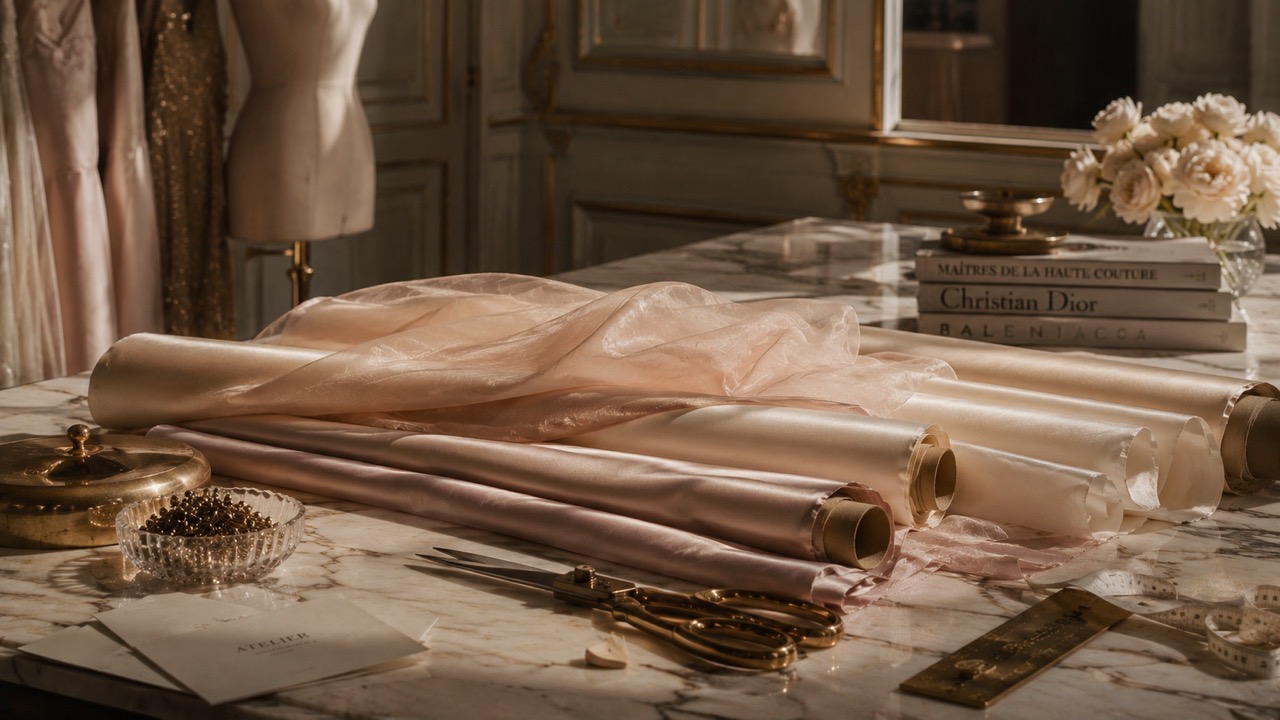
In an era when an algorithm can predict your trouser preference before you have articulated it yourself — when machine learning has rendered the mass market so efficient that a decent suit can be had for a fraction of what it cost a generation ago — there remains a peculiar, almost defiant pleasure in choosing the opposite. In choosing to stand in a fitting room on Savile Row while a cutter takes forty-seven measurements of your frame. In choosing to wait six months for a pair of shoes built on a last carved to the unique topography of your feet. In choosing the specific over the general, the personal over the produced, the slow over the instant. Bespoke, in 2026, is not merely a consumer preference. It is a philosophical position.
The Row Endures
Savile Row’s survival confounds those who predicted its obsolescence. The street that dressed Wellington, Churchill, and the Beatles continues to dress the discerning — not because it offers better cloth than ready-to-wear (the same mills supply both) but because it offers something the factory cannot: a relationship with a single cutter whose understanding of your body deepens over years, whose institutional memory of your preferences resides not in a database but in a pattern kept in brown paper, filed under your name in a dusty archive alongside patterns cut for your father and, conceivably, your grandfather.
The Neapolitan tradition offers a counterpoint — equally handmade but philosophically distinct. Where the English suit constructs the body, the Neapolitan suit observes it. At Kiton’s Arzano workshops, a single jacket passes through the hands of fifty artisans over twenty-five hours of work. The shoulder is unpadded, the chest uncanvassed — or rather, canvassed so lightly that the fabric appears to float against the body rather than encase it. At Cesare Attolini, the son and grandson of the man who invented the Neapolitan shoulder in the 1930s continue to refine an approach that privileges ease over armour. These are not merely different tailoring traditions; they are different philosophies of the body — different answers to the question of what a suit is for.
The Bespoke Shoe: Anatomy and Art
Nowhere is the case for bespoke more physically compelling than in shoes. The human foot is a structure of twenty-six bones, thirty-three joints, and more than a hundred muscles, tendons, and ligaments — no two arrangements identical, no two gaits precisely the same. A factory last accommodates a statistical average; a bespoke last maps an individual reality. At John Lobb’s Paris workshop, the lastier carves a wooden form to your foot’s precise measurements — accounting for the higher arch on the left, the slightly longer second toe on the right, the bunion developing at the first metatarsal. The resulting shoe does not merely fit; it corresponds. It is the difference between a translation and a native speaker.
Berluti adds another dimension — the patina, hand-applied in a process that Olga Berluti elevated to art form in the 1990s. Each pair is coloured not with a uniform dye but with successive layers of pigment, built up and burnished to create depth and variation unique to that individual pair. The colour, like the fit, belongs to one person. It cannot be replicated because it was never planned — it emerged through the interaction of hand, pigment, and leather in a specific, unrepeatable sequence of decisions.
Scent Made to Measure
The logic of bespoke extends beyond the sartorial. At Roja Dove’s Burlington Arcade salon, a private consultation begins not with fragrance but with conversation — about memory, preference, the smell of your grandmother’s garden or the particular quality of air in a city you love. From this portrait of olfactory autobiography, Dove constructs a fragrance that exists in one formulation, for one person. The bottle bears no name but yours. The composition references no existing perfume. It is, in the fullest sense, an original — created from the same palette available to every perfumer but combined in a sequence that serves only your skin chemistry, your emotional landscape, your life.
Floris, holding a Royal Warrant since 1820, offers a similar service from their Jermyn Street premises — though their approach draws more explicitly on their historical archive. A client might request “something that evokes the house’s 1890 character” or “a masculine floral in the tradition of your Edwardian formulas.” The perfumer works within these parameters, creating something new that nonetheless belongs to a lineage. It is bespoke in both senses — made to individual order, and made within a tradition that gives the individual creation context and depth.
The Philosophy of the Particular
What unites these disparate practices — the Savile Row fitting, the Neapolitan shoulder, the bespoke last, the personal fragrance — is not price, though all are expensive. It is a shared refusal of the generic. In choosing bespoke, one asserts that the particularities of one’s body, one’s taste, one’s life, warrant specific attention. Not because one is important — the democratisation of bespoke is one of the quiet revolutions of the past decade, with younger makers offering entry points far below the traditional houses — but because specificity itself is important. Because the well-made thing, made for a known person, carries a meaning that the mass-produced thing, however excellent, cannot.
The algorithm knows what you want before you want it. Bespoke asks a different question — not what you want, but who you are. It demands self-knowledge, patience, and the willingness to engage in a creative dialogue with a maker whose expertise exceeds your own. In return, it offers something no algorithm can generate: an object that exists because you exist, that fits no one else, that carries in its making a record of your particular presence in the world. In an age of infinite choice, this irreducible specificity may be the last true luxury — the one thing that cannot be recommended, replicated, or rendered redundant by the next generation of machine intelligence.