
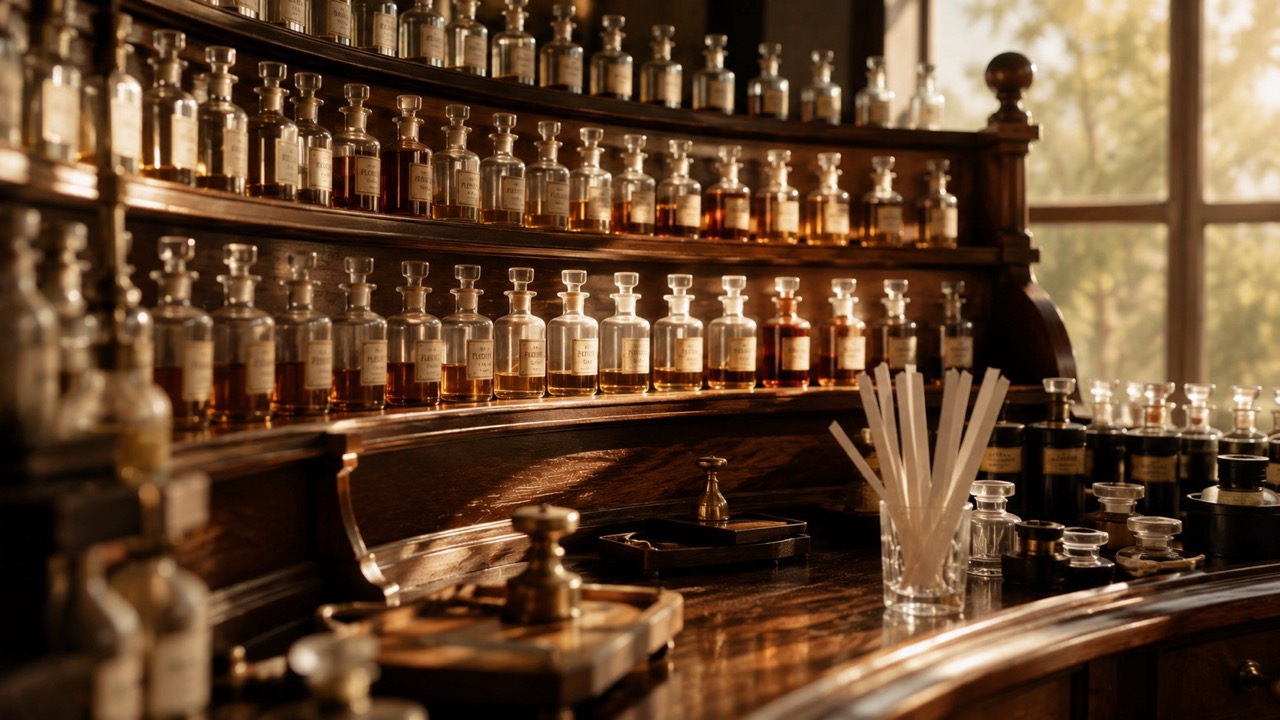
A perfume begins as nothing — a brief, a mood, sometimes a single word scrawled on a creative director’s notepad. “Sunrise over wet stone.” “The inside of a church in July.” “A woman who has just made a decision.” From these dissolving impressions, a master perfumer must construct something as precise and load-bearing as architecture — a composition in which every element supports every other, in which structure is invisible but essential, in which the experience of moving through the creation unfolds in time the way moving through a building unfolds in space.
The Education of a Nose
At ISIPCA in Versailles — the school founded by Jean-Jacques Guerlain in 1970, still the world’s most prestigious training ground for perfumers — students spend their first two years simply learning to smell. Not to compose, not to create, but to identify, memorise, and mentally catalogue several hundred raw materials. Each student builds an internal library: the green-violet leaf note of Givaudan’s Hedione, the animalic warmth of synthetic musks, the sharp medicinal facets of natural vetiver from Haiti versus the cleaner profile of Javanese. This library must be accessible instantly, the way a pianist accesses scales — not through conscious recall but through trained reflex.
Givaudan’s in-house perfumery school in Paris operates on similar principles but with an even longer timeline. Students spend up to five years in training before they are permitted to work on a commercial brief. The attrition rate is extraordinary. Of those who enter, perhaps one in ten will become working perfumers. Of those, fewer still will achieve the status of maître parfumeur — a distinction that, like the title of maestro in Murano, is conferred by recognition rather than examination.
The Architecture of a Composition
The language perfumers use to describe their work is borrowed, revealingly, from architecture and music. A fragrance has a structure: top notes that greet you at the door, a heart that constitutes the living space, a base that provides foundation. But these are not simply layers stacked one upon another; they are interdependent systems. A citrus top note may be present precisely to create contrast that makes the heart’s rose absolute feel deeper. A vetiver base may exist not for its own character but for the way it anchors and extends a fleeting jasmine in the middle register.
Jean-Claude Ellena, for decades the in-house nose at Hermès, described his approach as “writing with light.” His compositions — Terre d’Hermès, Un Jardin sur le Nil — are notable for what they omit. Where other perfumers build dense, layered structures, Ellena subtracts, reducing a formula to its essential gestures, the way a Japanese ink painter reduces a landscape to three brushstrokes. His fragrances feel transparent, spacious, as though you can see through them to the idea behind them. This is minimalism as a positive aesthetic choice — not poverty of imagination but discipline of it.
Three Noses, Three Philosophies
Francis Kurkdjian, whose Baccarat Rouge 540 has become one of the defining fragrances of the contemporary era, works with the precision of an engineer. His compositions are meticulous in their calibration — every ingredient measured to achieve a specific effect on skin at a specific distance. Where Ellena’s work suggests watercolour, Kurkdjian’s suggests technical drawing: exact, intentional, every line justified. His fragrances do not evolve so much as reveal — layers becoming perceptible as the structure warms against skin, like a building slowly lit from within.
Daniela Andrier, nose at Givenchy and the creator of Prada’s defining fragrances, brings a romanticism to her work that neither Ellena nor Kurkdjian would claim. Her compositions — Prada Amber, Infusion d’Iris — possess an emotional warmth, a sense of human presence, that transcends technical admiration. Where Ellena constructs light and Kurkdjian constructs precision, Andrier constructs feeling. Her fragrances are rooms in which something has just happened, or is about to happen — charged with the emotional residue of human life.
The Brief and the Breakthrough
The reality of modern perfumery is that most master noses work to briefs from fashion houses — commercial constraints that specify target demographics, price points, even the colour of the juice. The great perfumers transcend these constraints not by ignoring them but by finding within them unexpected creative space. The brief becomes a frame — like a sonnet’s fourteen lines or a haiku’s seventeen syllables — within which genuine invention remains possible.
A perfumer may submit fifty, a hundred, two hundred modifications of a formula before a brief is satisfied. Each modification is a micro-decision with cascading consequences — increase the bergamot by half a percent and the entire drydown shifts; substitute a synthetic oud for a natural one and the heart loses three hours of longevity. The process is iterative, obsessive, and largely invisible to the person who will eventually spray the finished fragrance and decide, in three seconds, whether they like it.
This invisibility is perhaps the perfumer’s greatest distinction from other artists. A painter signs their canvas. An architect’s name appears on the building. But for most of perfumery’s history, the nose remained anonymous — a ghost composer whose work was attributed to the fashion house. Only in recent decades has this begun to change, with niche houses crediting their perfumers and the rise of the perfumer-auteur who creates under their own name. It is a welcome correction. The person who constructs a great fragrance from nothing — from a brief, a memory, and six hundred available raw materials — is practising an art form as rigorous, as intellectually demanding, and as worthy of recognition as any in the creative world.