
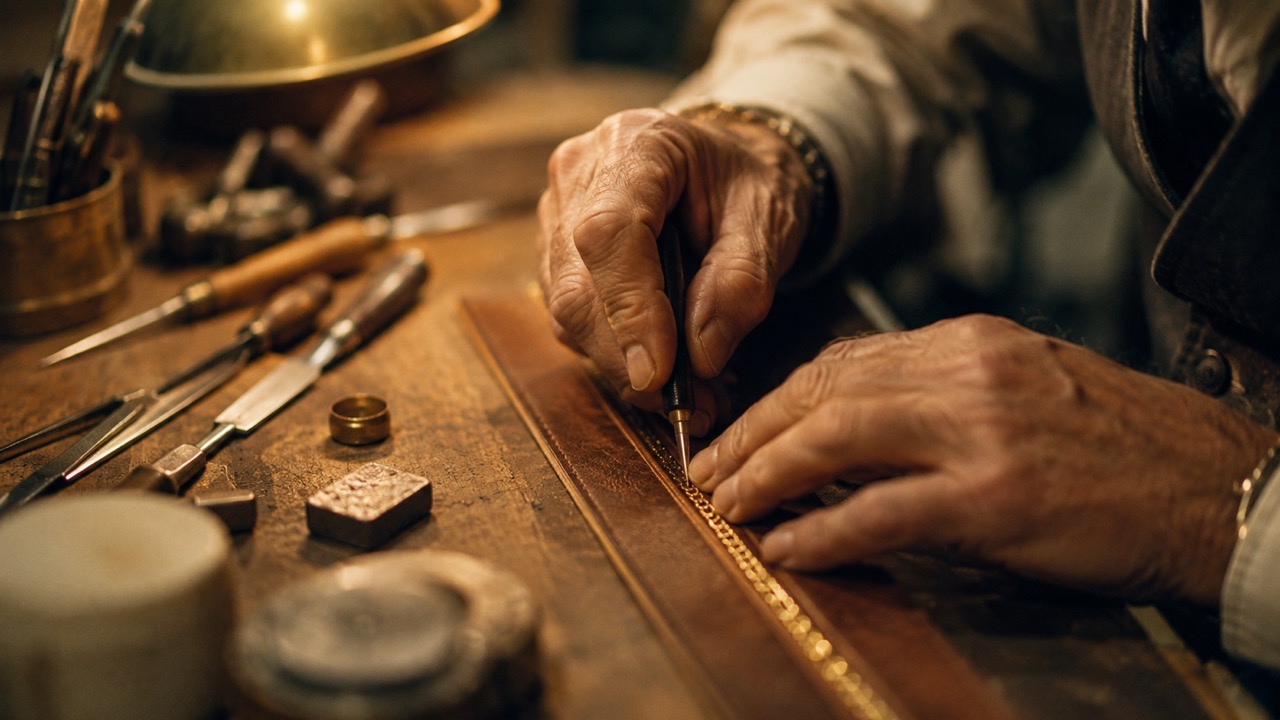
In the basement workshop of a Savile Row house whose name I have been asked not to print, a cutter holds a length of Super 180s cloth to the light. He tilts it slowly, watching the weave catch and release the grey London morning. “Anyone can source this cloth now,” he says, without looking up. “Anyone with a credit card and a shipping address. What they cannot source is my hand, my eye, the forty years my hand and eye have spent learning this cloth.” He sets down the fabric and picks up his shears. “That,” he says, cutting, “is what you are paying for. The story of this particular hand.”
The Honest Currency
We live in an age of extraordinary copies. A factory in Shenzhen can reproduce the form of almost anything — a watch case, a handbag silhouette, a chair profile — with tolerances that would have seemed miraculous a generation ago. The democratisation of manufacture has made quality available at every price point, which is, by any reasonable measure, a civilisational triumph. But it has also created a crisis of meaning. If the object itself can be replicated, what remains that cannot? The answer, increasingly, is the story. Not the marketing narrative — the slick campaign, the brand mythology — but the genuine, verifiable, irreducible story of making. Provenance. The who, the where, the how, the how long.
Provenance is luxury’s last honest currency because it is the one thing that resists duplication. You can copy a pattern; you cannot copy a lineage. You can reproduce a technique; you cannot reproduce the four decades of daily practice that elevated that technique into art. In a market saturated with excellent surfaces, provenance is depth — the vertical axis of meaning that separates the made from the merely manufactured.
The Lacquerware Master’s Hands
In Wajima, on the Noto Peninsula of Japan, a lacquerware artisan named Kirimoto-san applies the twenty-third coat of urushi to a single bowl. Each coat must dry in conditions of precise humidity — too dry and it cracks, too wet and it clouds — and each is polished before the next is applied. The process takes six months. The bowl, when finished, will have a depth of surface that seems to contain its own light, a quality the Japanese call nuri no tsuyami — the lustre of layered lacquer. No machine can replicate this. Not because the technology does not exist, but because the value of the object resides precisely in the six months, the twenty-three coats, the hands that know by touch alone when the humidity is right.
Kirimoto-san learned from his father, who learned from his father. The knowledge is not written down. It lives in muscle memory, in the particular angle of wrist that distributes urushi evenly, in the ability to read weather through skin. When Kirimoto-san retires, if he has no apprentice willing to commit the necessary decades, this knowledge will vanish from the world as completely as if it had never existed. This is the fragility that gives provenance its power — it is always, inherently, at risk of being lost.
Florentine Paper, Florentine Time
At Giulio Giannini e Figlio, operating from the same Florentine workshop since 1856, the marbled papers are made by a process that has not fundamentally changed since it arrived in Europe via Turkey in the seventeenth century. Pigments are floated on a bath of carrageenan size. A comb is drawn through the floating colour. A sheet of paper is laid on the surface and lifted away, carrying the pattern. The entire operation takes perhaps ninety seconds. But the ninety seconds depend on decades of understanding — how temperature affects viscosity, how different pigments behave on the size, how the particular mineral content of Florentine water produces effects unavailable elsewhere.
You can buy marbled paper made by machine. It is perfectly acceptable. But it does not carry the slight irregularities that mark a human hand — the fractional hesitation at the turn of a comb stroke, the individual decision to add one more drop of ochre. These imperfections are not flaws; they are signatures. They are proof that a specific person, on a specific day, in a specific place, made a series of unrepeatable decisions. This is what provenance means at its most fundamental: evidence of individual consciousness applied to material.
The Unfakeable Signature
The philosophical case for provenance is ultimately a case for meaning in a world of abundance. When everything is available, nothing is significant. When any form can be reproduced, form alone cannot carry value. What carries value is the irreproducible — the context, the lineage, the accumulated knowledge that manifests in an object but exists beyond it. A bespoke suit is not merely cloth cut to your measurements; it is a relationship with a cutter whose understanding of the human body has been refined over four decades of daily practice. A bottle of wine from a specific terroir is not merely fermented grape juice; it is a liquid record of one year’s weather in one particular place, made by hands that know that place across generations.
In the end, provenance is not a luxury category — it is a philosophical position. It is the assertion that how something came to exist matters as much as what it is. That the story of making is not separate from the object made, but integral to it. That in a world capable of copying anything, the most valuable thing is that which cannot be copied: the truth of a particular life, applied with patience and skill, to the transformation of raw material into something that carries meaning beyond its function. This is luxury’s last honest currency — not because it is expensive, but because it is real.