
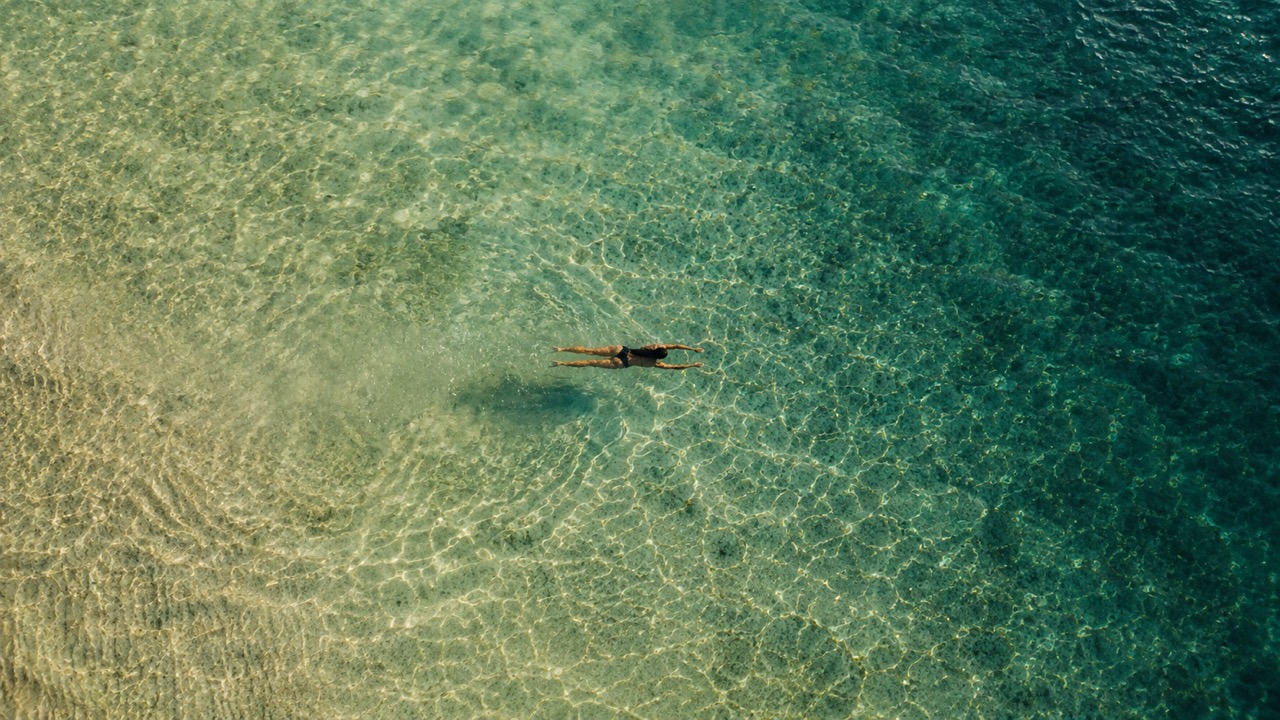
The beaches that appear in travel magazines have already been lost. The moment a stretch of sand receives its first drone photograph on social media, its essential quality — that feeling of having arrived somewhere unmediated by the expectations of others — begins to evaporate. What follows is a different category entirely: beaches that remain difficult to reach, that demand commitment, that reward the traveller willing to hike, charter, or simply know where to look. These are not secrets in any absolute sense — locals have always known them. But they remain, by virtue of geography or access, beyond the reach of casual tourism.
Cala Goloritzé, Sardinia
On the eastern coast of Sardinia, where the limestone cliffs of the Supramonte plunge vertically into the Tyrrhenian Sea, Cala Goloritzé exists in a state of geographical defiance. There is no road. Access is either by boat from Cala Gonone — a forty-minute journey along a coast of staggering verticality — or by foot, descending the Codula di Goloritzé canyon trail, a ninety-minute hike that drops five hundred metres through holm oak and juniper before delivering you, sweat-soaked, to water of such transparent turquoise that the boats above appear to hover in mid-air. The beach itself is small — perhaps fifty metres of white pebbles beneath a natural limestone pinnacle that rises like a cathedral spire from the cliff face. Since 1995 it has been a UNESCO natural monument. No facilities exist. The effort of arrival is the price of admission, and it filters the crowd with absolute effectiveness.
The Calanques, Cassis to Marseille
Between Cassis and Marseille, the coastline fractures into a series of narrow limestone inlets — the calanques — where cliffs of brilliant white stone plunge into water of impossible blue-green depth. Calanque d’En-Vau is the finest: accessible only by a steep trail through Aleppo pine forest or by kayak from Cassis harbour. The beach, when you reach it, is a sliver of white gravel at the base of hundred-metre cliffs, the water so clear and cold that swimming feels like entering another element entirely. In high summer, access is restricted by fire risk — the trails close when the mistral raises the danger level. This combination of difficulty, regulation, and sheer geological drama maintains a quality that the Riviera beaches to the east lost decades ago.
The Pelion Peninsula, Greece
The Pelion — that mountainous finger of land extending into the Aegean between Volos and the Pagasetic Gulf — contains some of the Aegean’s most extraordinary beaches precisely because it lacks the infrastructure of the islands. Fakistra, on the eastern coast, requires a descent through dense forest on a path that becomes a scramble in its final section — reward: a cove of white pebbles beneath cliffs hung with vegetation, accessible to perhaps thirty swimmers at a time. Mylopotamos, slightly more accessible, splits into two beaches divided by a natural rock arch, the further one requiring a swim through a sea cave to reach. Papa Nero, backed by dense plane trees, feels less Mediterranean than subtropical. The Pelion’s beaches share a quality rare in the Aegean: verdancy. The mountains behind trap moisture, creating a lushness that turns the coast into something closer to the Amalfi than to the Cyclades.
Sveti Stefan, Montenegro
The islet of Sveti Stefan — connected to the Montenegrin mainland by a narrow causeway — has been an Aman resort since 2011, its medieval fishing village converted into one of the Adriatic’s most extraordinary hotels. But the beach that matters is not the private one on the islet itself. It is the Queen’s Beach — Kraljičina Plaža — accessible through the grounds of the adjacent Villa Miločer, a former royal summer residence. Set in a cove of pink-grey sand backed by century-old olive groves and parasol pines, it offers perhaps sixty metres of shoreline with views across the bay to the fortified islet. Access requires either a guest booking or a significant day-use fee — a financial filter that achieves what geography achieves elsewhere.
Navagio, Zakynthos — By Private Charter
Navagio — Shipwreck Beach — is the most photographed beach in Greece, which would normally disqualify it from any list of hidden places. But the standard experience — a day-cruise catamaran delivering hundreds of visitors to the beach for a forty-minute visit — bears no resemblance to arriving by private charter at dawn, when the rusting hull of the MV Panagiotis sits alone on the white sand and the cliffs form a three-sided amphitheatre of limestone rising three hundred metres above. The beach is accessible only by sea; the timing is everything. At seven in the morning, before the excursion boats depart from Zakynthos port, Navagio offers fifteen minutes of genuine solitude in one of the Mediterranean’s most dramatic landscapes. A local skipper from Porto Vromi can deliver you there and back before breakfast.
What these beaches share is not obscurity but difficulty — the requirement that the visitor bring effort, knowledge, or commitment rather than merely arrive. In an era when every coastline has been photographed, reviewed, and geotagged, the last form of exclusivity available to the beach-seeker is not wealth but willingness: the readiness to hike, to charter, to wake early, to earn the swim.