
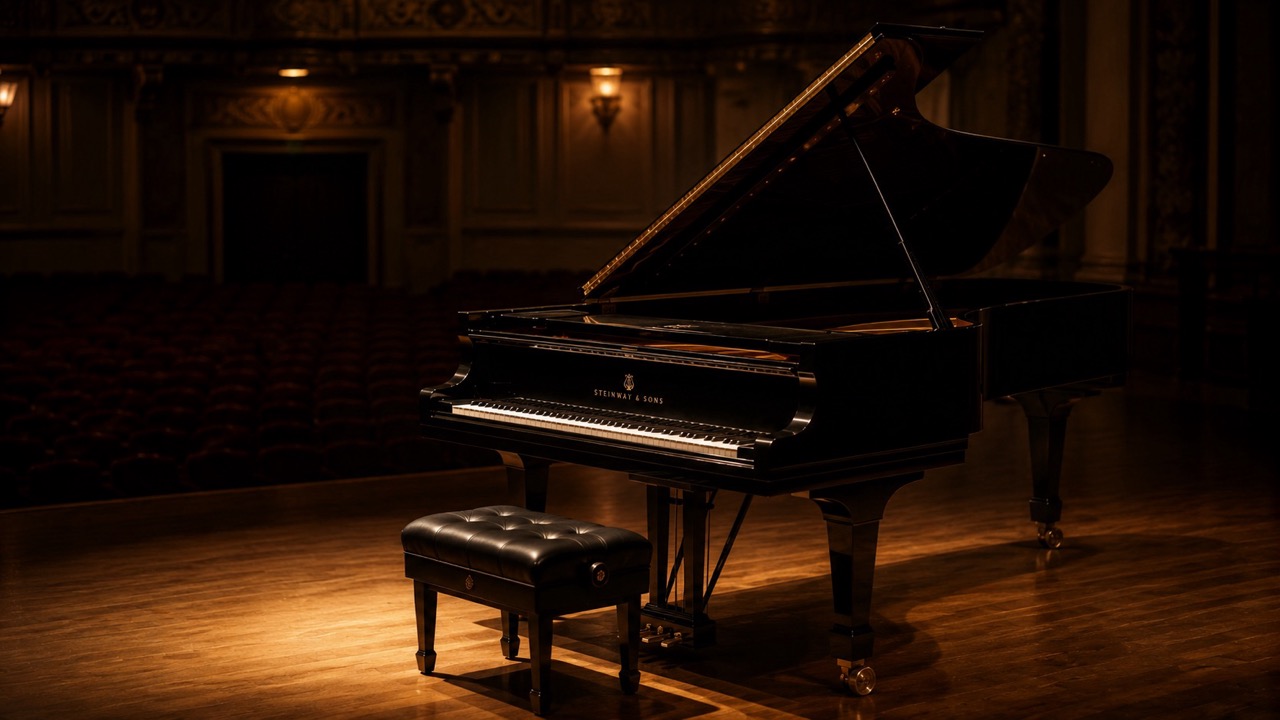
The difficulty with classical music is not access — it is navigation. The obvious masterpieces arrive unbidden: they score films, furnish advertisements, accompany hold music with grotesque inappropriateness. What remains hidden is a parallel canon of works that reward the attentive listener with something rarer than familiarity — the shock of genuine discovery. What follows is not a syllabus but an invitation: eight compositions that, once heard in the right performance, reshape one’s understanding of what music can contain.
Ravel: Pavane pour une infante défunte (1899)
Ravel was twenty-four when he composed this pavane — a slow processional dance for a Spanish princess who never existed. The piece is seven minutes of sustained, aching restraint: a melody so simple it seems inevitable, harmonies that shift beneath it like light through water. The orchestral version of 1910 adds colour without weight. Ravel himself disliked the piece in later years, calling it “poor in form” — but its very imperfection is its power. It captures something that more ambitious works cannot: the quality of memory itself, the way the past arrives not as narrative but as sensation. The recording by the Orchestre de Paris under Jean Martinon finds precisely the right tempo — unhurried but never static.
Satie: Gymnopédies (1888)
Everyone knows the Gymnopédies; almost no one has heard them properly performed. The usual interpretation — wistful, nostalgic, pretty — misses Satie’s radical intention entirely. These are not sentimental pieces. They are experiments in stasis, in what happens when music refuses to develop. The pianist Reinbert de Leeuw, in his revelatory 1979 recording, takes tempos so slow that each chord becomes an event in itself — not a step in a progression but a freestanding sonic object. Heard this way, the Gymnopédies anticipate ambient music by a century. They are less compositions than environments: spaces to inhabit rather than narratives to follow.
Barber: Adagio for Strings (1936)
Samuel Barber’s Adagio has been so thoroughly appropriated by grief — funerals, memorials, films about death — that hearing it freshly requires deliberate effort. Strip away the associations and what remains is a single sustained act of emotional architecture: a theme that climbs and climbs, each voice entering to push the line higher, until the music reaches a silence so devastating that the resumption of sound afterwards feels like resurrection. The original string quartet version (the second movement of his Opus 11) is more intimate and arguably more devastating than the orchestral arrangement that made it famous. The Emerson String Quartet’s recording preserves the chamber-music scale that gives the climax its unbearable proximity.
Górecki: Symphony No. 3, “Symphony of Sorrowful Songs” (1976)
For fifteen years after its composition, Górecki’s Third Symphony remained virtually unknown outside Poland. Then, in 1992, a recording by the London Sinfonietta with soprano Dawn Upshaw became an improbable bestseller — three million copies of a seventy-minute symphony built on three slow movements of devastating simplicity. Each movement sets a text of maternal grief: a fifteenth-century lamentation, a prayer inscribed on a Gestapo cell wall by an eighteen-year-old girl, a Silesian folk song of a mother searching for her son killed in war. The music — vast, slow, constructed from canons of almost medieval purity — creates a space large enough to contain all of these griefs simultaneously without ever becoming manipulative.
Messiaen: Quatuor pour la fin du temps (1941)
Composed and first performed in a German prisoner-of-war camp in Silesia, Messiaen’s Quartet for the End of Time is music from the extremity of human experience. Written for the instruments available among the prisoners — clarinet, violin, cello, and piano — its eight movements draw on the Book of Revelation and Messiaen’s idiosyncratic Catholic mysticism. The fifth movement, “Louange à l’éternité de Jésus” — a long, infinitely slow melody for cello and piano — achieves a stillness that genuinely seems to exist outside time. This is not metaphor: Messiaen’s rhythmic language, derived from Indian tala and Greek prosody, deliberately subverts the listener’s sense of temporal progression.
Pärt: Spiegel im Spiegel (1978)
Arvo Pärt’s “Mirror in the Mirror” is music reduced to its absolute minimum: a piano arpeggio, ascending and descending in a fixed pattern, while a single melodic line — originally for violin, though versions exist for cello and other instruments — traces a slowly expanding arc above it. The piece is an exercise in what Pärt calls tintinnabuli — a compositional method where one voice follows the melodic line while another sounds only the notes of the triad. The result is music of such transparency that it seems less composed than discovered — as though Pärt had found a naturally occurring acoustic phenomenon and simply transcribed it. The effect on the listener is immediate and physical: the breathing slows, the attention sharpens, the boundary between interior and exterior experience becomes permeable.
Dutilleux: Tout un monde lointain (1970)
Henri Dutilleux remains scandalously under-known outside France — a composer of fastidious perfectionism who published barely a dozen major works across a career spanning sixty years. His cello concerto, inspired by Baudelaire, is among the finest of the twentieth century: five movements that shimmer between dream and wakefulness, the solo cello navigating orchestral textures of extraordinary iridescence. Mstislav Rostropovich, who commissioned and premiered it, called it the greatest cello concerto since Dvořák. The recording by Jean-Guihen Queyras with the Orchestre Philharmonique de Radio France captures both the sensuality of the writing and its structural rigour.
Listening as Practice
These works share a quality that distinguishes them from the standard repertoire: they demand a particular quality of attention. They are not background music, nor are they virtuosic spectacles. They ask the listener to slow down, to inhabit duration differently, to allow silence and space their full weight. Heard properly — in sequence, perhaps, across an evening with good headphones and no interruption — they constitute not merely a playlist but an education in listening itself.