
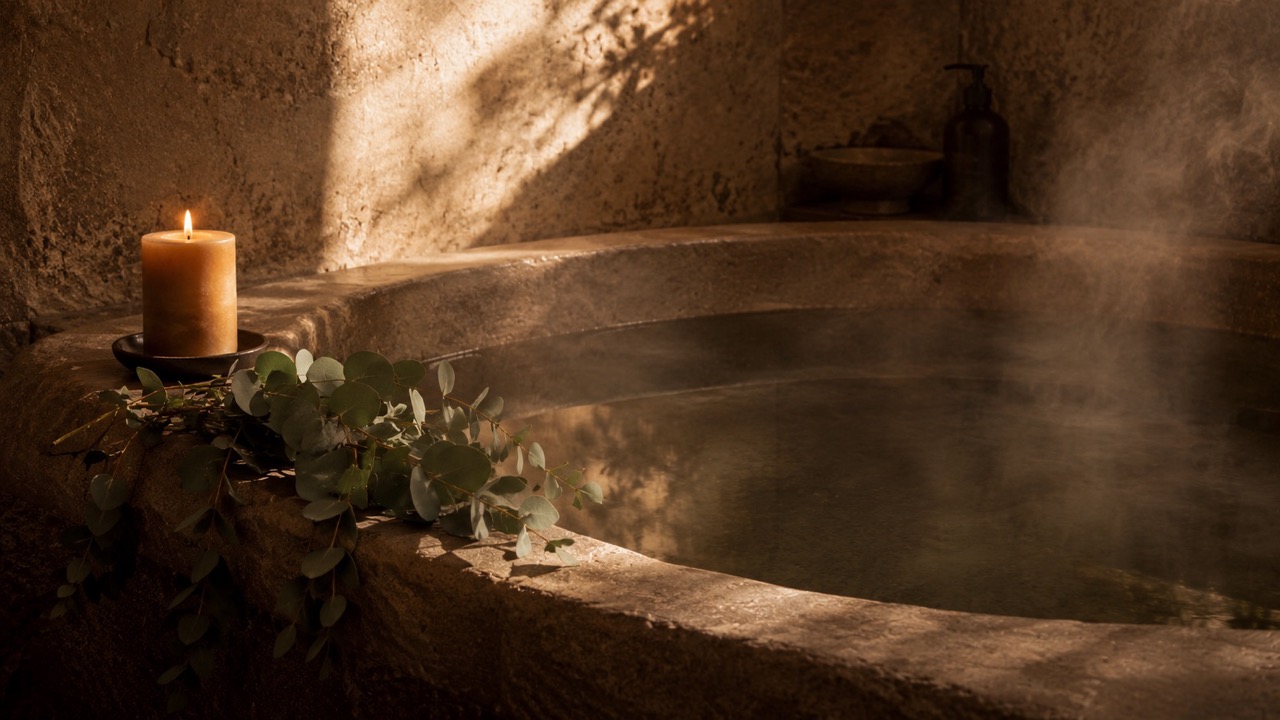
There is a moment in the hammam — after the heat has softened everything, after the attendant has scraped away what feels like a former self — when the body becomes an instrument of pure sensation. Water strikes marble and the sound is older than memory. This is not wellness in any contemporary sense. This is ritual so deeply embedded in civilisation that to experience it is to touch something pre-modern, pre-individual, profoundly communal.
The Ottoman Hammam: Architecture of Social Life
The hammam was never merely a bathhouse. In Ottoman cities from Istanbul to Aleppo, it functioned as parliament, salon, and confessional simultaneously. Women negotiated marriages beneath its domes. Men conducted commerce between steam rooms. The architecture itself — that progression from cool entrance hall through warm room to hot room — mirrors a philosophical journey from the public self to something more essential. The great hammams of Istanbul — Çemberlitaş, built by Sinan in 1584, or the Kılıç Ali Paşa hammam, meticulously restored to its sixteenth-century splendour — remain working institutions precisely because the ritual they house never became merely historical. The heated marble göbektaşı at the centre of each hot room is still a place where social hierarchies dissolve in steam and sweat.
The Japanese Onsen: Purification as Spiritual Practice
Where the hammam is social, the onsen is metaphysical. The Japanese bathing tradition draws from Shinto notions of purification — misogi, the cleansing of impurity — and Buddhist contemplation. The ritual washing before entering the communal pool is not hygiene; it is preparation of the self for a shared sacred space. In the mountain onsen of Nyuto in Akita Prefecture, or the coastal rotenburo of Shirahama, the mineral waters carry geological time. The distinction between an onsen and a mere hot bath is legally defined in Japan: the water must emerge from the earth at above 25 degrees Celsius and contain specific mineral concentrations. This is bathing as communion with landscape. The naked body in the outdoor pool, snow falling on exposed shoulders, the volcanic water almost unbearably hot — this is an experience of elemental forces that no spa can simulate.
The Russian Banya: Endurance as Brotherhood
The banya operates on an entirely different principle: intensity as purification. The parilka — the steam room heated to temperatures that would alarm Western health authorities — is an arena of endurance. The venik, bundles of birch or oak branches soaked in hot water, are used to beat the skin into a state of furious circulation. Then the plunge — into snow, into an ice lake, into a barrel of cold water. The shock is the point. In the Sanduny Baths in Moscow, operational since 1808, or the simpler country banyas of rural Russia, the ritual creates a particular form of intimacy: vulnerability shared, discomfort endured together, the post-banya state of euphoric exhaustion that Russians call being “light.” It is perhaps the most physically demanding bathing tradition on earth, and the most bonding.
The Nordic Sauna and Cold Plunge: Silence and Severity
The Finnish sauna — and its Scandinavian variations — strips the bathing ritual to its essence: heat, cold, silence. There is no attendant, no massage, no social performance. The löyly, the steam that rises when water is thrown on the kiuas stones, is almost a living presence in the room. The tradition is democratic in a way that is specifically Nordic — every apartment building has a sauna, every summer cottage has one by the lake. The cold plunge that follows is not punishment but completion: the nervous system reset, the skin alive, the mind emptied. In Helsinki’s Löyly or the older Kotiharju sauna, the practice remains utterly unchanged from its medieval origins.
The Korean Jjimjilbang: Community as Comfort
The jjimjilbang represents something altogether different: bathing as total social infrastructure. These vast complexes — open twenty-four hours, containing multiple pools at different temperatures, saunas infused with jade or charcoal or salt, sleeping rooms, restaurants, cinemas — function as a parallel city. Families spend entire weekends within their walls. The culture of the jjimjilbang is one of radical unselfconsciousness: bodies of every age and shape move through the spaces with a naturalness that Western cultures have largely lost. Dragon Hill Spa in Seoul, spread across seven floors, offers an experience closer to a Roman thermae than to anything in the modern wellness industry — a place where the boundaries between bathing, eating, socialising, and sleeping dissolve entirely.
Living Heritage, Not Museum Pieces
What unites these traditions is their refusal to become merely historical. Each remains a living practice because each addresses something that no amount of private bathrooms can satisfy: the need for communal vulnerability, for ritual that marks the passage from one state to another, for the body to be acknowledged as something shared rather than merely owned. To experience these traditions at their source — not in hotel interpretations or Western adaptations — is to understand how profoundly different civilisations have answered the same fundamental question: what does it mean to be clean, to be renewed, to be human in the company of other humans?