
The city that Alexander of Macedon founded in 331 BC at the western edge of the Nile Delta was, for six centuries, the intellectual capital of the Mediterranean world — a place where Greek philosophy, Egyptian mysticism, Jewish theology, and the accumulated astronomical and mathematical knowledge of Mesopotamia converged in a creative ferment that has no parallel until, perhaps, Renaissance Florence. That the physical evidence of this extraordinary period has largely vanished — the Great Library consumed by fire, the Pharos lighthouse toppled by earthquakes, Cleopatra’s palace submerged beneath the harbour — makes Alexandria not less interesting but more so. It is a city whose present is haunted by the magnitude of what it once was, and the excavations of the past three decades have begun, with tantalising specificity, to recover fragments of that lost world.
The Catacombs of Kom el-Shoqafa: Where Civilisations Merge
Descending the spiral staircase into the Catacombs of Kom el-Shoqafa is an experience that prepares the visitor for nothing and everything simultaneously. Carved into the bedrock in the first and second centuries AD, these burial chambers represent the most complete surviving example of the cultural synthesis that defined Alexandrian civilisation. Egyptian gods wear Roman armour. Greek architectural orders frame pharaonic funeral scenes. Medusa’s head appears above a sarcophagus decorated with the traditional Egyptian motifs of the winged solar disc and the sacred serpent. The effect is not confusion but coherence — the coherence of a city that understood, two millennia before the concept became fashionable, that cultures do not merely coexist but interpenetrate, producing something richer and stranger than any of their constituent parts.
The Bibliotheca Alexandrina: Ambition Reborn
The modern library that opened on the Corniche in 2002 — the Bibliotheca Alexandrina, designed by the Norwegian firm Snøhetta — is not a reconstruction of the ancient Library of Alexandria. It is something more interesting: a contemporary response to the idea that the ancient library represented. The building itself is a statement of extraordinary architectural ambition: a tilted disc of glass and aluminium rising from a reflecting pool, its exterior wall carved with characters from every known writing system, its interior a single vast reading room descending in eleven cascading levels toward the sea. The collection — eight million volumes and growing, supplemented by specialised museums of antiquities, manuscripts, and the history of science — is assembled with an eclecticism that honours the original library’s mission of universal knowledge.
The Manuscript Museum, housed within the Bibliotheca complex, contains treasures that reward the patient visitor: medieval Arabic scientific texts whose diagrams anticipate Renaissance anatomical illustration by centuries, illuminated Coptic gospels whose colour has survived a thousand years, early printed editions of works that trace the transmission of Greek philosophy through Arabic translation back into the Latin West. The story these manuscripts tell — of knowledge travelling, transforming, and surviving across cultures and centuries — is Alexandria’s own story, and the museum tells it with a scholarly rigour and a visual beauty that justify the journey alone.
The Underwater Archaeology: Cleopatra’s Submerged Palace
In 1998, the French underwater archaeologist Franck Goddio announced the discovery of the remains of the royal quarter of ancient Alexandria — including what are believed to be the palaces of Cleopatra and the Ptolemaic dynasty — submerged in the harbour by a series of earthquakes and tsunamis in the fourth and eighth centuries. The ongoing excavation, conducted by Goddio’s team in collaboration with the Egyptian Supreme Council of Antiquities, has recovered statuary, architectural fragments, and ritual objects of remarkable quality, many of which are now displayed at the Alexandria National Museum and in travelling exhibitions worldwide. The site itself, visible through glass-bottomed boats and accessible to qualified divers, offers an experience that has few equivalents in archaeology: the sensation of swimming through the rooms where one of history’s most consequential figures held court.
The Living City: Beyond the Ruins
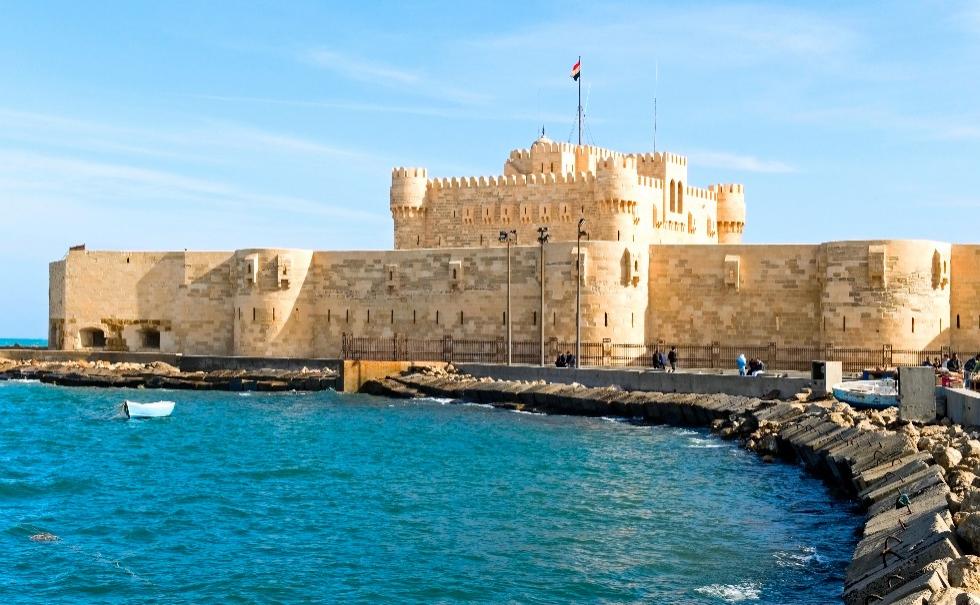
The Alexandria that exists today — sprawling, noisy, magnificently indifferent to its own legend — is a city that rewards the visitor who looks beyond the archaeological. The Corniche, the seafront promenade that sweeps the length of the Eastern Harbour, is one of the great urban walks of the Mediterranean, particularly at sunset when the light turns the buildings pink and the fishermen cast their lines from the Qaitbay Citadel — the fifteenth-century fortress built on the foundations of the Pharos lighthouse. The cafés of the Raml Station district still carry traces of the cosmopolitan Alexandria of Cavafy and Durrell and Forster — the Greek-Egyptian-French-Italian city of the early twentieth century whose vanished elegance haunts the modern metropolis like a perfume that has almost, but not quite, dissipated.
The fish restaurants along the harbour — Balbaa, Kadoura, the dozens of unnamed establishments where the catch is displayed on ice and the customer selects before it is cooked — serve seafood of a freshness and simplicity that more elaborate culinary traditions often fail to match. A plate of grilled sea bass, a bowl of tahini, a basket of baladi bread, and a view across the harbour to the spot where the Pharos once stood: it is a meal that contains, in its modesty, the entire history of a city that taught the world what civilisation could be.