
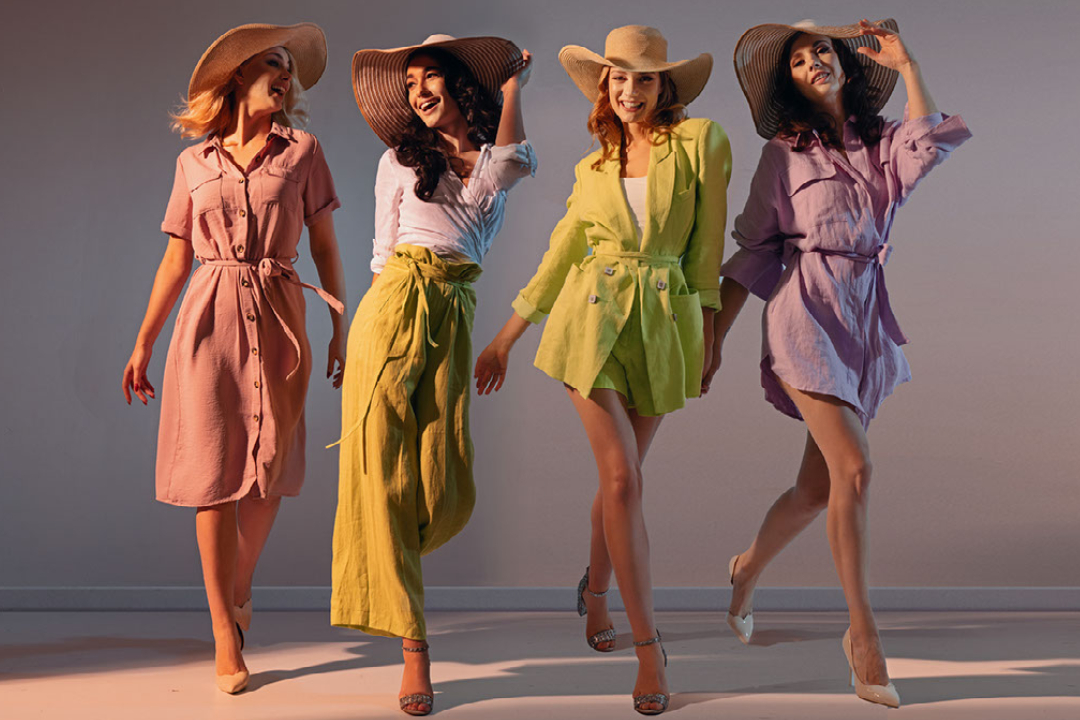
Colour is the most immediate language fashion speaks. Before cut, before fabric, before silhouette registers fully in the eye, colour has already made its declaration. It arrives ahead of everything else — a flash of cobalt at the end of a corridor, the particular amber of a cashmere coat glimpsed through a café window, the quiet authority of a woman in undiluted black among the bright confusion of a summer crowd. To understand colour as a fashion language is to understand that you are always, whether consciously or not, making a statement the moment you dress.
The Psychology of the Palette
Colour theory in fashion operates quite differently from its counterpart in painting or interior design, because clothing moves through the world. A garment is not seen against a fixed background but against the shifting contexts of street, office, candlelit table, and bright afternoon, and it is seen in relationship to its wearer’s particular colouring — the tone of skin, the depth of eye, the warmth or coolness of hair. This dynamic quality is what makes colour in fashion endlessly more complex than it first appears, and why the same shade of rose that transforms one complexion simply disappears against another.
The most sophisticated dressers understand this principle at an intuitive level developed through years of attention. They know their own palette not as a set of flattering colours — a limiting concept that tends to produce wardrobes of beige timidity — but as a set of relationships. They know which saturated tones they can carry and which require the mediation of a neutral; they understand that the same ivory reads entirely differently in linen versus satin; they have learnt that navy, worn close to the face, does something particular to the light in their eyes that no stylist told them but they discovered themselves, in front of a mirror on an ordinary morning.
The Architecture of a Colour Wardrobe
Building a wardrobe around colour requires the same structural thinking as any serious architectural project. Begin with the foundation: one, perhaps two, neutral tones that carry the weight of the wardrobe’s everyday life. For many women this is navy or camel or a warm stone grey — a colour with enough depth to be interesting but enough quietude to support any number of companions. These are not compromise colours but load-bearing ones, and they deserve the highest quality of cloth and construction the budget allows, because they will be worn constantly and forever.
Above this foundation, introduce what might be called the tonal signature: a family of colours that share a temperature and mood and recur throughout the wardrobe in different forms. The great couturiers understood this instinctively. Valentino’s reds — never one red but a family of reds, from vermillion to raspberry to the particular deep crimson that became a kind of trademark — created a chromatic world that was instantly recognisable as his own. Emilia Wickstead’s soft, considered palette of dusty rose, powder blue, and sage green similarly constitutes a world unto itself, one you can inhabit entirely or enter through a single piece.
Monochrome as Mastery
Among the most powerful and most underused strategies in colour dressing is the considered monochrome: a single colour, worn head to foot with variations in tone and texture. The effect, when it works, is one of extraordinary authority. It removes the cognitive noise of colour contrast and directs the eye entirely to silhouette, proportion, and surface — the architectural qualities of the clothes themselves. A woman in all-ivory, the silk of her blouse reading differently from the wool of her wide trousers, the leather of her shoes offering yet a third interpretation of the same theme, is making a statement that no colour combination could match for composed confidence.
The key to successful monochrome lies precisely in those tonal variations. An outfit in which every element is the exact same shade reads as uniform rather than intentional. Introduce depth through sheen and matte, thickness and fineness, and the ensemble becomes a study in refined complexity rather than simplicity’s lesser sibling.
The Brave Gesture
There is, finally, a case to be made for colour used with real courage — the single piece that transforms the entire register of a wardrobe and reveals something about its wearer that more cautious dressing conceals. The entirely classic wardrobe animated by one pair of emerald-green heels. The impeccable neutral palette interrupted by a coat in terracotta so vivid it practically glows. The woman who wears fuchsia to a funeral — not from carelessness but from a deep understanding that life, fully inhabited, includes moments of chromatic intensity that no occasion can suppress.
These gestures work precisely because they are singular. The rest of the wardrobe must be sufficiently considered that the brave colour reads as choice rather than accident, confidence rather than confusion. Colour courage is always contextual: the louder the note, the quieter everything around it must be, so that the gesture registers not as noise but as music.
Dress in colour with attention, with intention, and with the willingness to be seen — fully, brilliantly, and exactly as you are.