
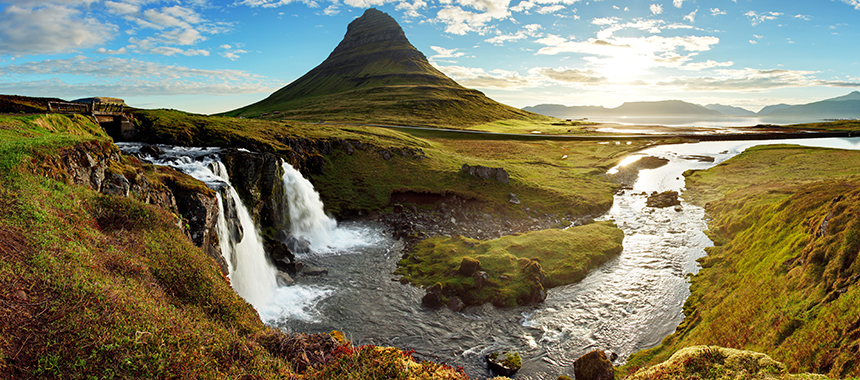
There are places on this earth where the usual categories of experience — beautiful, dramatic, serene — simply fail to apply. Iceland is such a place. It exists in a register of its own, somewhere between geological adolescence and mythological antiquity, a landscape so recently erupted from the ocean floor that it still seems to be deciding what it wishes to become. To travel here is not to sightsee so much as to witness: the planet in the act of making itself, raw and magnificent and entirely indifferent to the observer’s presence.
A Land Still Becoming
The Icelandic interior — the Highlands, as they are simply and accurately called — is one of the last genuinely uninhabited places in Europe. No roads cross it in winter. No farms have taken root in its obsidian plains, its sulphur fields, its rivers of glacial meltwater the colour of old pewter. To drive the F-roads in a high-clearance vehicle in the brief and luminous summer is to understand why the Norse settlers, arriving in the ninth century, populated this landscape with elves and hidden people: only supernatural occupants could explain the sensation that the land is watched, attended to, alive in some pre-rational sense that defies the vocabulary of the secular tourist.
Fire Beneath the Ice
Iceland sits upon the Mid-Atlantic Ridge, where the Eurasian and North American tectonic plates pull slowly apart — at roughly the rate at which a human fingernail grows. This geological position accounts for everything that makes Iceland extraordinary: the geysers that erupt on schedule with the precision of a Swiss mechanism, the hot springs that pool in volcanic rock at temperatures calibrated for contemplation, the lava fields draped in luminescent moss that softens all edges and muffles all sound. The Snæfellsjökull glacier, which Jules Verne chose as the entrance to the centre of the earth, rises from a peninsula on the western coast with the composed authority of a monument that has been there since before the concept of monuments existed.
The Silence That Changes You
What cannot be adequately photographed, and what no travel writer has yet fully captured, is the silence of Iceland. Not the silence of absence — the countryside is full of wind, of rushing water, of geothermal exhalation — but the silence of scale. When you stand on the Fjaðrárgljúfur canyon’s rim, watching its serpentine walls drop forty metres into a ribbon of jade-green river, the sensation is not of looking at something beautiful. It is of being absorbed by something vast. The ego shrinks to an appropriate size. This is the particular gift Iceland offers the overstimulated traveller: a recalibration of proportion.
Reykjavik: The World’s Most Northerly Capital
Iceland’s capital is a city that has never quite convinced itself it is a city. With a population of just over two hundred thousand, Reykjavik feels more like a large, exceptionally design-conscious village that happens to possess a world-class restaurant scene, a concert hall — Harpa — whose glass facade refracts the northern light like a prism the size of a cathedral, and a nightlife that begins past midnight and continues until the Arctic summer sun rises again without ever having fully set. The city rewards the flaneur: its painted corrugated-iron houses, each a different shade of ochre or cerise or slate blue, its harbour lined with trawlers and whale-watching vessels, its streets smelling perpetually of geothermal warmth and fresh bread.
Chasing the Aurora
To witness the Northern Lights for the first time is to understand, viscerally, why our ancestors invented gods. The aurora borealis does not merely appear; it performs. On a clear October or February night — the optimal seasons for viewing — it begins as a pale greenish smear on the northern horizon, easily mistaken for light pollution from a distant town. Then it moves. It ribbons across the sky with an organic, liquid urgency, shifting from green to violet to white to a deep, trembling crimson at the edges. It fills the dome of heaven with something that the eye registers as colour but the body registers as presence. The most hardened sceptic, standing in an Icelandic field at midnight with the Milky Way overhead and the aurora dancing in front of them, tends to grow very quiet.
The Water, the Steam, the Stone
To understand Iceland is to understand its relationship with water in all its states. The glaciers — Vatnajökull alone is larger than all the glaciers of continental Europe combined — feed the rivers that carve the canyons that define the landscape. The same geothermal heat that drives the volcanoes warms the water that Icelanders have, with characteristic pragmatism, piped directly into their swimming pools, their radiators, their showers. The Blue Lagoon, that most famous of geothermal spas, has been somewhat diminished by its own celebrity, but the principle it represents — soaking in mineral-rich water at thirty-eight degrees while snow falls on your shoulders — is one of the most genuinely restorative acts available to the modern traveller.
An Island That Demands Return
First-time visitors to Iceland frequently report the same experience upon departure: an acute, almost physical sense that they have left too soon. They have glimpsed something — a quality of light on a glacier, a particular configuration of lava and sky, a moment of silence so complete it could be heard — and they need to return to understand it properly. This is not wanderlust in the ordinary sense. It is something more specific: the recognition that Iceland has offered them access to a dimension of experience they had not known was missing, and that they are not yet ready to live without it.