
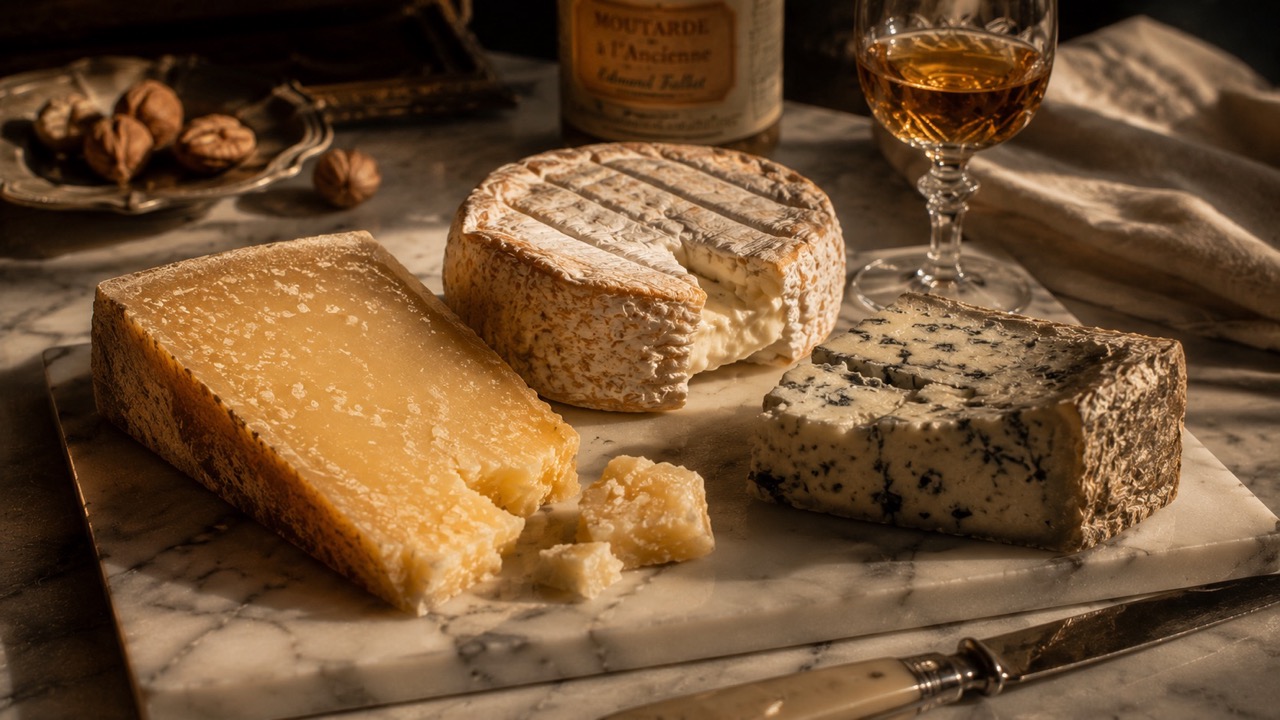
There is no food on earth that has generated more reverence, more legislation, more ceremony, and more genuine passion than cheese. From a single act of biological transformation — the coagulation of milk by the action of rennet and bacteria — humanity has, over the course of several millennia, produced something approaching ten thousand distinct varieties, each a precise reflection of landscape, climate, breed, microorganism, and the accumulated knowledge of the hands that made it. To speak seriously about cheese is to speak about civilisation itself: about the slow, patient intelligence of farmers and affineurs, about the way a mountain valley in the Jura or a limestone cave in Roquefort can express itself through a living food with the specificity of a fingerprint.
The Great Traditions: Mountains, Time, and Milk
Comté begins in the Jura Massif, in the green highland meadows that straddle the border between France and Switzerland, where Montbéliarde cows graze on a botanically diverse pasture that imprints itself on the milk in ways that laboratory analysis can measure but never fully explain. The wheels — enormous, each requiring approximately five hundred litres of milk — are pressed and salted and transferred to the caves of master affineurs, where they will age for a minimum of four months and often considerably longer. A Comté at eighteen months develops a complexity that ranges across caramel, toasted hazelnut, fruit compote, and a mineral note as clean as mountain air. At thirty-six months, it approaches something almost geological: dense, crystalline, with a persistence on the palate that outlasts the conversation.
Parmigiano-Reggiano is the cheese of time and patience made material. Its production zone — the provinces of Parma, Reggio Emilia, Modena, and parts of Bologna and Mantua — is legally protected, and the cheese produced within it has not substantially changed its method in seven centuries. The wheels that are broken open at the Parma market by the traditional studded knife, splitting along the granular fault lines that eighteen months of ageing has created, release an aroma of extraordinary concentration: warm dairy, dried fruit, umami of an almost meaty depth. It is a cheese designed to be eaten in shards, not slices, and it rewards attention in the way that only genuinely complex things do.
Époisses de Bourgogne is, by any reasonable measure, the most transgressive cheese in the French canon, which is an achievement in a country that has never confused transgression with vulgarity. Washed repeatedly during its affinage with marc de Bourgogne — the grape spirit distilled from Burgundian wine pomace — its rind develops a rust-orange, wrinkled surface of considerable aromatic ambition, while the interior softens to a paste of silk and salt and a funkiness that demands the confidence of a wine of equivalent character. Napoleon reputedly declared it his favourite cheese. The French government, in a moment of considerable wisdom, awarded it Appellation d’Origine Protégée status. Époisses is not for the timid, but then the most interesting things rarely are.
England, La Mancha, and the Case for Raw Milk
The raw-milk cheese tradition of England — unfairly overshadowed by its Continental counterparts in the global imagination — is producing some of the most exciting wheels on earth. Montgomery’s Cheddar from Somerset, made with raw milk from the family’s own herd and aged in cloth for twelve months or more, achieves a crumble and a depth of flavour that no pasteurised imitation has ever approached. Stilton, the great blue of the East Midlands, carries a creaminess beneath its veining that distinguishes it from all other blues of the world. And the smaller producers — Kirkham’s Lancashire, the aged Stichelton, Quicke’s cloth-bound cheddar — are writing a new chapter in a tradition that the industrial interlude of the twentieth century came perilously close to erasing.
Manchego, produced on the high central plateau of La Mancha from the milk of Manchega sheep, is the cheese of Don Quixote’s landscape — spare, sun-bleached, surprisingly austere. At three months it is mild and buttery; at twelve months it has developed a firm, almost crumbling texture and a flavour of dried apricot, lanolin, and warm stone that speaks unmistakably of the meseta. The basket-weave pattern pressed into its rind during moulding is among the most beautiful gestures of vernacular cheese design anywhere in the world.
The Architecture of a Serious Cheese Board
A serious cheese board is not an accumulation but a composition — and like any composition, it benefits from contrast, tension, and resolution. Begin with variety of milk: a cow’s milk cheese of some age, a sheep’s milk cheese of moderate complexity, and a goat’s milk cheese of freshness and acidity that will provide the palate with relief. Then consider texture: something firm and crystalline alongside something semi-soft and unctuous alongside, if the company permits, something washed-rind and boldly aromatic. Temperature matters enormously: cheese removed from the refrigerator an hour before serving will have bloomed into its full aromatic potential, where cold cheese offers only a fraction of what it contains.
The accompaniments deserve equal care. Raw honeycomb — particularly a dark, aromatic variety, buckwheat or chestnut — brings a sweetness that amplifies rather than competes with aged sheep’s or blue cheeses. Quince paste, membrillo in the Spanish tradition, provides the tartness that cuts through fat. Good bread — a sourdough with genuine acidity, or a walnut loaf — functions as a neutral vehicle. And fruit, sparingly: a ripe pear with aged Comté, dried figs with a strong blue, fresh grapes with a fresh chèvre.
The Law and the Preservation of Greatness
The protected designation systems of Europe — the French AOC, the European PDO — exist not as bureaucratic impositions but as the accumulated legal expression of a simple truth: that the greatest foods are irreproducible outside their specific conditions of origin, and that without protection, the economic pressures of industrial food production will erase them. The terroir of Roquefort — that particular limestone plateau of the Combalou, with its fissures called fleurines through which cool, humid air circulates continuously — cannot be relocated. The milk of the Montbéliarde cow on Jura pasture cannot be replicated in a factory. These laws are, in their way, acts of cultural preservation as significant as any museum’s acquisition policy.
To eat the great cheeses of the world with full attention is to understand something important: that human ingenuity, applied patiently over generations to a single extraordinary ingredient, can produce a form of beauty as moving and as various as anything else our civilisation has made. The milk sours, the rennet binds, the cave breathes — and something unprecedented comes into being. It always will.