
The Greeks have a word — meraki — that describes the act of doing something with soul, with creativity, with love, leaving a piece of yourself in the work. It is a word that applies, with unusual precision, to an entire season. The Greek summer is not merely a meteorological condition but a state of being, a quality of life practiced with a collective expertise refined over millennia. It is the season that defines the national character, that draws the diaspora home and the world to those shores, that turns the ordinary acts of swimming and eating and sitting in the evening air into something that feels, without exaggeration, like a form of grace.
The Light That Changes Everything
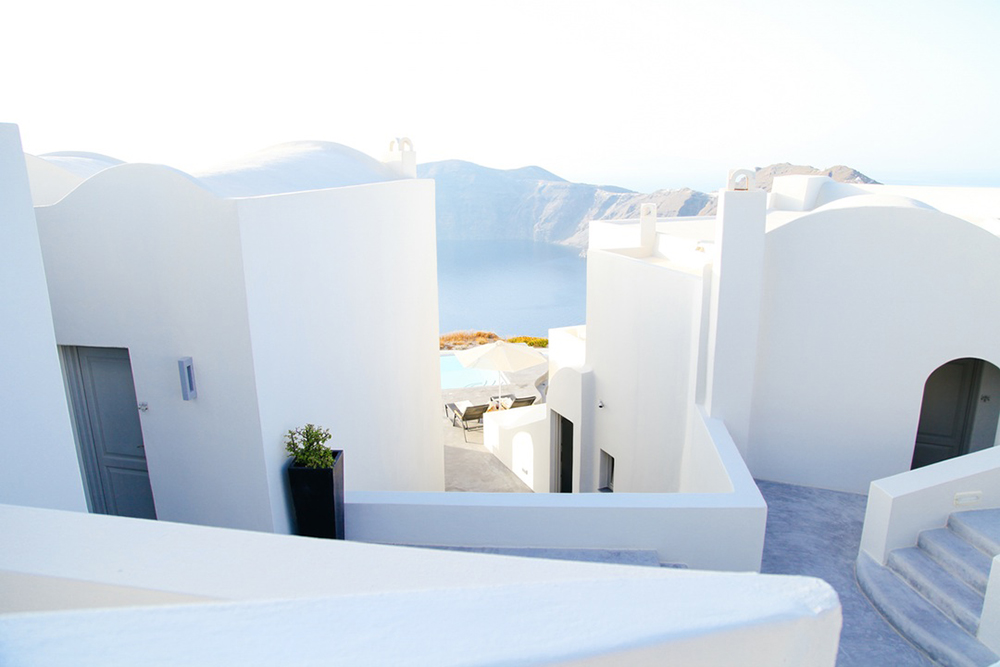
The Aegean light has been discussed at such length by poets, painters, and travel writers that one approaches the subject with some caution. And yet it demands acknowledgment, because it is genuinely unlike light elsewhere and because it is the animating force behind everything the Greek summer offers. It is not merely bright — southern light is bright everywhere — but clarifying, the kind of light that makes edges sharp and distances comprehensible and colours vibrate at frequencies that seem slightly beyond the everyday register. The white walls of the Cyclades are not merely a stylistic choice but a response to this light; they exist to reflect and amplify it, to make the villages seem to glow from within. Turner understood this when he painted the Greek coast. Kazantzakis understood it when he wrote about Crete. Every visitor understands it within the first hour of arrival.
Santorini: The Iconic and the Overlooked
Santorini’s iconic status — those blue domes above the caldera, the sunset from Oia that has been photographed so many millions of times that it exists simultaneously as a real place and as a global cliché — should not deter the intelligent traveller. The island rewards those who look past the obvious, who venture south from Oia to the villages of Pyrgos and Megalochori, where medieval kastelia and wine estates sit among fields of the unusual assyrtiko grape whose shallow roots draw minerals from volcanic soil to produce a white wine of extraordinary, briny distinction. The island’s finest properties — Canaves Oia Suites, Grace Santorini, Katikies — have positioned themselves along the caldera edge with an understanding of what drama in hospitality can mean, but the island’s secret pleasures are found in its interior.
The Peloponnese: History Made Habitable
For the traveller who finds the island circuit too familiar, the Peloponnese offers a Greek summer of deeper historical grain. This peninsula — connected to the mainland by the Corinth Canal, that extraordinary 19th-century engineering achievement — contains within its borders Mycenae, where Schliemann unearthed the Gold Mask of Agamemnon and the traces of a civilisation older than Classical Greece; Epidaurus, where the ancient theatre’s acoustics are so perfect that a whisper from the stage carries to the 55th row without amplification; and Mystras, the Byzantine ghost city on the slopes of the Taygetos mountains where the final flowering of Byzantine art occurred before the Ottoman conquest ended it in 1460.
The Mani peninsula, the middle finger of the Peloponnese pointing south toward Africa, is one of the most singular landscapes in Europe — a place of stone tower houses built by feuding clans, of a coastline so dramatic and unsupplied with beaches that it has been spared mass tourism entirely, of an olive oil tradition so ancient and so serious that the trees are individually registered with the local authorities.
The Islands Beyond the Postcard
Greece encompasses more than 6,000 islands, of which approximately 230 are inhabited. The Dodecanese in the east, closer to Turkey than to Athens, includes Rhodes with its medieval city — the most complete surviving medieval town in Europe — and the smaller island of Symi, its harbourside neoclassical facades painted in ochre and terracotta and amber, its waterfront among the most beautiful in the Aegean. The Ionian islands in the west — Corfu, Kefalonia, Zakynthos — have a different character entirely, their architecture carrying Venetian and British inflections, their interiors green and lush in ways the Cyclades are not, their olive trees ancient beyond reckoning.
The Table in Summer
The Greek summer table is one of the most pleasurable in the world, and its pleasures are fundamentally simple. Tomatoes that taste of August heat and volcanic soil. Octopus grilled over charcoal and eaten at a table with one’s feet near the water. Feta made from sheep’s milk and cured in barrels since before any living person can remember. The mezedes culture — the perpetual sharing of small dishes, the rhythm of eating that is also a rhythm of conversation — is a social technology of great sophistication, a way of extending a meal across an entire afternoon without it ever seeming excessive.
The Season as Philosophy
What the Greek summer ultimately offers is not merely a holiday destination but a philosophical proposition: that the good life is available to anyone willing to slow down sufficiently to receive it. The sea is there. The light is there. The table, properly attended, is always there. What is required of the visitor is only the willingness to participate fully, to set aside the northern European instinct for scheduling and productivity, and to understand that an afternoon spent doing nothing more than swimming, eating, and watching the light change on the water is not wasted time but time lived at its most complete. The Greeks have understood this for a very long time. The summer is their annual proof.