
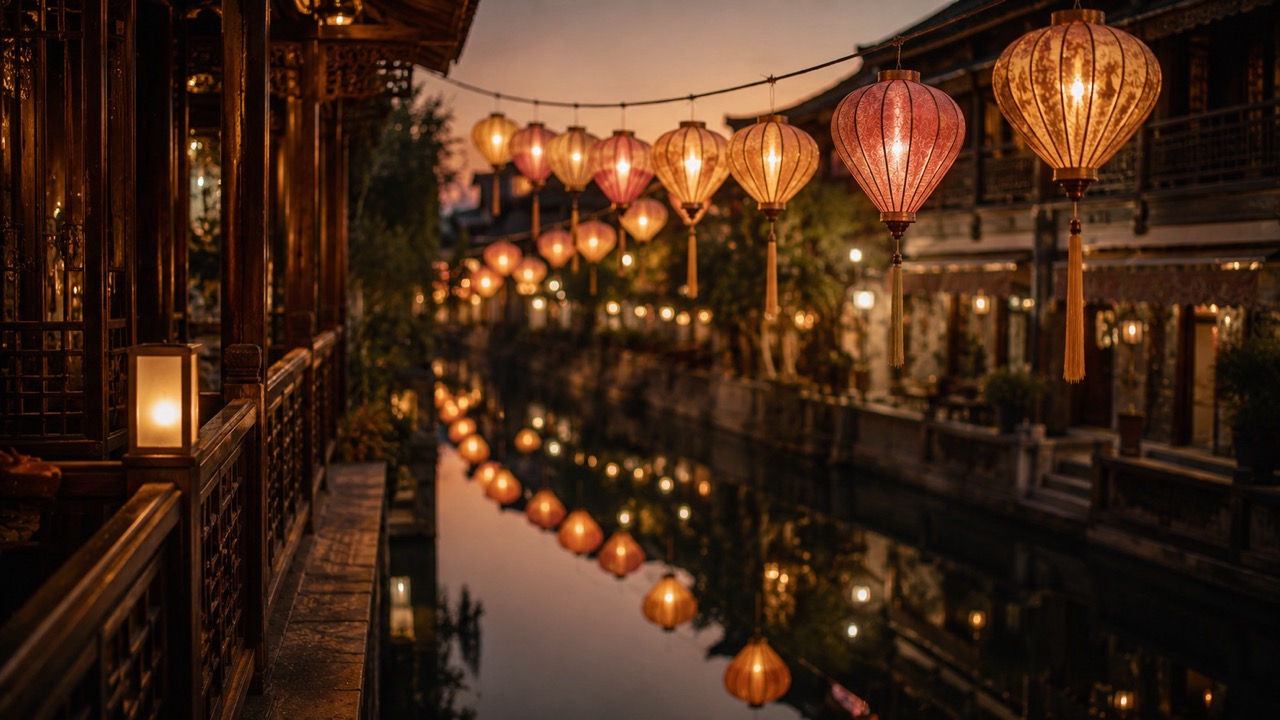
There are destinations that announce themselves with fanfare — and then there is Taiwan, which offers itself quietly, with a kind of dignified restraint that only deepens the longer one stays. This island of twenty-three million, perched at the conjunction of Pacific and East Asian currents, has long been overlooked by travellers drawn to its more theatrical neighbours. And yet those who arrive with unhurried curiosity discover something increasingly rare in the contemporary world: a place of exceptional cultural density, still largely unmediated by the machinery of mass tourism, still fundamentally itself.
A Civilization in Miniature
Taiwan’s cultural identity is layered with a complexity that rewards patient attention. The island has absorbed Austronesian indigenous traditions, centuries of Chinese dynastic influence, a half-century of Japanese colonial transformation, and the particular intellectual energy of a mid-twentieth-century diaspora — all compressed into a terrain slightly smaller than Switzerland. The result is not confusion but a kind of concentrated brilliance: temples of extraordinary craftsmanship where incense smoke drifts past offerings of modernist sculpture; night markets that operate with the efficiency and produce-intelligence of the finest European food halls; museums whose collections rival those of major continental institutions yet receive a fraction of the international attention.
The National Palace Museum in Taipei alone holds one of the most significant collections of Chinese imperial art anywhere on earth — jade carvings of impossible delicacy, bronze vessels of the Shang dynasty, Song dynasty landscapes whose brushwork achieves a quietude that no reproduction can approximate. An early morning visit, before the tour groups arrive, with a private guide who understands the objects’ provenance and symbolic registers, is an experience that adjusts the scale of one’s understanding of human civilisation.
Taipei: Elegant, Unexpected
The capital repays exploration at the pace of a flaneur rather than a tourist. Da’an and Zhongshan districts reward afternoons spent drifting between independent bookshops, tea houses with single-origin oolong selections presented with ceremonial care, and architecture that ranges from Japanese colonial elegance to the particular modernity of a society that rebuilt itself with speed and intention. The restaurant culture is sophisticated beyond most visitors’ expectations: Taiwanese chefs trained in Kyoto, Paris, and Copenhagen have returned to the island with refined technique applied to local ingredients, producing tasting menus that reference traditional Taiwanese flavours through a vocabulary of extraordinary precision.
The tea culture, in particular, deserves sustained attention. Taiwan’s high-mountain oolongs — Alishan, Li Shan, Da Yu Ling — are among the most sought-after teas in the world, produced at altitudes that create the slow oxidation responsible for their distinctive floral complexity. In the teahouses of Jiufen or the dedicated tea rooms of Taipei’s Wanhua district, a gongfu ceremony conducted by a practitioner of genuine knowledge is not a performance for visitors but a daily ritual whose contemplative structure seems expressly designed to restore clarity.
Beyond the Capital
The island’s interior is a revelation to those who venture beyond the coastal cities. The Central Mountain Range, its highest peaks exceeding three thousand metres, contains some of Asia’s most dramatic landscape: Taroko Gorge, where a river has spent millennia cutting through marble cliffs of vertiginous scale; the high plateau of Hehuan Mountain, above the treeline, where starfields of extraordinary density compensate for the altitude’s cold; the forested valleys of the eastern Rift Valley, where Ami and Puyuma indigenous communities maintain traditions of music, weaving, and ceremony that connect the island to prehistoric Austronesian culture.
The eastern coast, less developed than the west and dramatically scenic, offers a different tempo entirely. The small city of Hualien serves as gateway to both Taroko and to a coastline of wild beauty, where Pacific swells arrive unimpeded across open ocean and fishing communities live in a relationship with the sea that modernity has barely disturbed. Boutique properties in this region tend toward the architectural vernacular — wood, stone, integration with terrain — rather than the international luxury idiom, which makes them feel genuinely of their place.
The Grace of Taiwanese Hospitality
What finally distinguishes Taiwan for the culturally attentive traveller is not any single site or experience but the quality of the human encounter. Taiwanese hospitality operates without performance: it is warm, precise, and fundamentally generous in the sense that people share knowledge and time freely, without expectation. A shopkeeper in a Tainan incense market will explain the historical significance of each ingredient with the same care whether or not a purchase follows. A temple volunteer in Lugang will walk an interested stranger through the iconographic programme of a nineteenth-century altar screen because the information seems worth sharing.
This quality — generous, unhurried, rooted — is perhaps what the discerning traveller finds most sustaining. In an era when authenticity has become both marketing language and genuine scarcity, Taiwan offers the real thing: a living culture that has preserved its depth not through the amber of tourism but through the daily practice of its own traditions. To arrive here is to be quietly instructed in how civilisation, at its best, actually feels.