
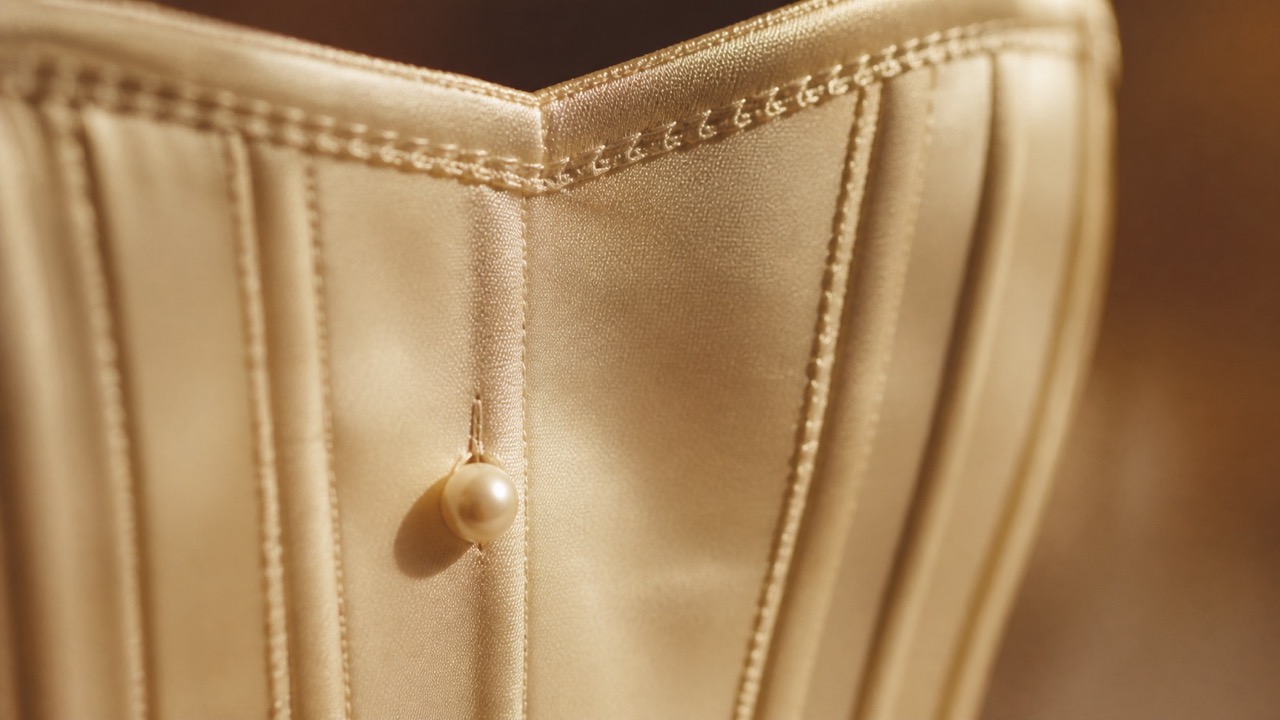
Few garments in the history of Western dress have carried a more contested freight of meaning than the corset. Simultaneously instrument of oppression and agent of empowerment, symbol of constraint and emblem of deliberate self-construction, it has been argued over, written about, burned in effigy, and triumphantly revived across five centuries of fashion history. What is remarkable is not that the corset survived all of this but that it emerges from its long cultural biography more complex and more interesting than it entered it — a garment that, far from resolving into a simple narrative of liberation or repression, continues to pose genuinely difficult questions about the relationship between clothing, the body, identity, and desire.
Origins: The Court and the Cage
The corset’s origins lie in the sixteenth-century courts of Europe, where the corps piqué — a stiffened bodice constructed from layers of fabric quilted with wool and later reinforced with whalebone or wooden busks — emerged as a tool for achieving the fashionable silhouette of the period: a long, flat-fronted torso that presented the body as a geometric proposition. Catherine de’ Medici, who brought Italian fashion sensibilities to the French court, is often credited with popularising the stiffened bodice in France; by the end of the sixteenth century, the garment had become inseparable from aristocratic female dress across the Continent.
What is crucial to understand about these early constructions is that they were not solely instruments of external imposition. Court women participated actively in the development and refinement of fashionable dress; the corset was one element of an elaborate sartorial vocabulary that distinguished the aristocratic body from its social inferiors. The ideal silhouette it produced was not naturalness but artifice — a sculptural achievement, a demonstration that the wearer inhabited a world of sufficient leisure and wealth to transform the body into art. This reading, uncomfortable as it may be to contemporary sensibilities, was not lost on the women who wore these garments.
The Victorian Cathedral of Fabric and Bone
By the nineteenth century, the corset had become simultaneously more extreme and more democratised. The development of the steel busk in the 1820s, followed by machine-manufactured steel spiral boning later in the century, made tightly laced corsets available to the middle and even working classes. The extreme tight-lacing that became a subject of fierce medical controversy in the 1880s — physicians warning of displaced organs, restricted breathing, and structural damage to the skeleton — was, in practice, considerably rarer than the popular imagination has subsequently supposed. Most Victorian women wore their corsets moderately laced, primarily as a foundation garment that smoothed and supported rather than dramatically compressed.
Yet the corset of the Victorian imagination, with its exaggerated hourglass achievements of eighteen-inch waists and its obvious associations with constraint, entered cultural memory as an emblem of female subjugation. The Rational Dress Society, founded in 1881, campaigned against it on grounds of health and female liberation. The Aesthetic Movement proposed loose, uncorseted dress as part of a broader project of sensory and intellectual freedom. These early reform movements planted the seed of an argument that would fully flower in the twentieth century.
Liberation and the Poiret Moment
Paul Poiret claimed in his memoirs to have liberated women from the corset — a claim that, like most of Poiret’s self-mythologising, contains truth and considerable exaggeration in equal measure. His hobble skirts, after all, imposed their own significant constraints upon the female body. What actually occurred in the first two decades of the twentieth century was not a simple liberation but a redistribution of emphasis: as the corset relaxed, the girdle arrived; as the stiff bodice loosened, the brassiere emerged. The body was not freed from external shaping but reshaped according to different aesthetic priorities. Coco Chanel’s genius was to make this shift feel radical while keeping the female body very much within a prescribed range of acceptable expression.
The feminist critique of the corset that gathered force through the 1960s and 1970s was more philosophically coherent: it argued not merely for a different silhouette but for an end to the proposition that women’s bodies required external architectural intervention to be acceptable. The bra-burning of feminist protest — largely mythologised, but culturally resonant — extended this argument to the broader project of foundation garments, positioning any deliberately shaping undergarment as complicit in female subjugation.
The Return: Westwood, McQueen, and the Corset’s Third Life
Which makes the corset’s late-twentieth-century return all the more culturally complex and interesting. Vivienne Westwood, whose engagement with historical tailoring and structural garments runs through her entire career, was among the first to reposition the corset not as a relic of oppression but as a vehicle for the most sophisticated kind of feminist argument: the reclamation of adornment and artifice as female choices rather than male impositions. Her corsets from the 1980s onward — elaborate, historically informed, worn as outerwear — proposed that there was nothing inherently liberating about shapelessness, and nothing inherently oppressive about choosing to shape the body as a deliberate aesthetic act.
Alexander McQueen took this argument further into the realm of pure aesthetic provocation. His corsets in collections such as Highland Rape and The Overlook were instruments of a complex, often disturbing dialogue about the female body, violence, beauty, and power. They were never simple; they could not be worn without activating an entire history of meanings. This was precisely their point. Under Alessandro Michele, Gucci’s romantic revival of corsetry brought warmth and eclecticism to the form — brocade and velvet, Renaissance associations, a deliberate dreaminess that positioned the corset as an element of sartorial storytelling rather than ideological statement.
Contemporary designers — Khaite’s body-conscious tailoring, the Nensi Dojaka school of structural underwear-as-outerwear, the proliferation of boning and busk references across ready-to-wear — continue to explore what the corset means when chosen freely, worn deliberately, and styled with full awareness of its history. The answer, it turns out, is that it means something different to every woman who puts one on: authority, playfulness, historical consciousness, erotic charge, theatrical pleasure. The corset was never simple. That it still is not may be the most interesting thing about it.